Most popular





Subscribe to our blog
Most recent
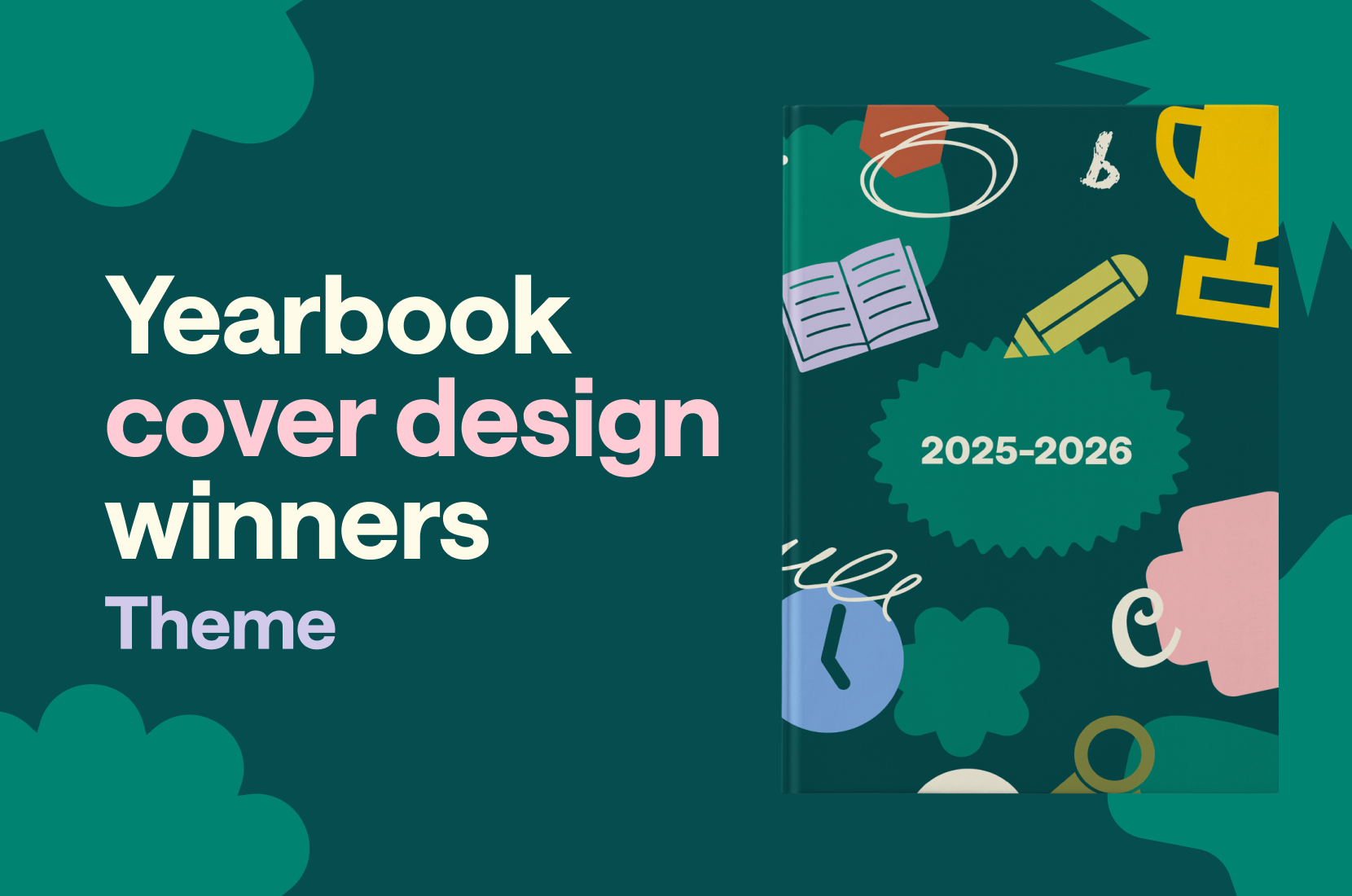
Theme Cover Winners 2026 Treering Yearbook Design Contest
Treering’s annual design contest celebrates the creativity, storytelling, and talent that make yearbooks meaningful. This year, we combined the contests for cover, custom pages, and spreads, creating our biggest challenge yet.
Your response was incredible.
Three groups of judges evaluated over 1,000 entries from parents and school leaders for
- Design quality
- Storytelling
- Visual impact
- Relevance to content
Many yearbook creators define theme as an aesthetic. We believe they are both visual and verbal. The strongest entries didn’t just look beautiful. They captured the spirit of their schools through headlines, repeating visual elements, and coverage.
Bottom line: the spreads in each of yearbooks below reinforce the story that began on the cover.
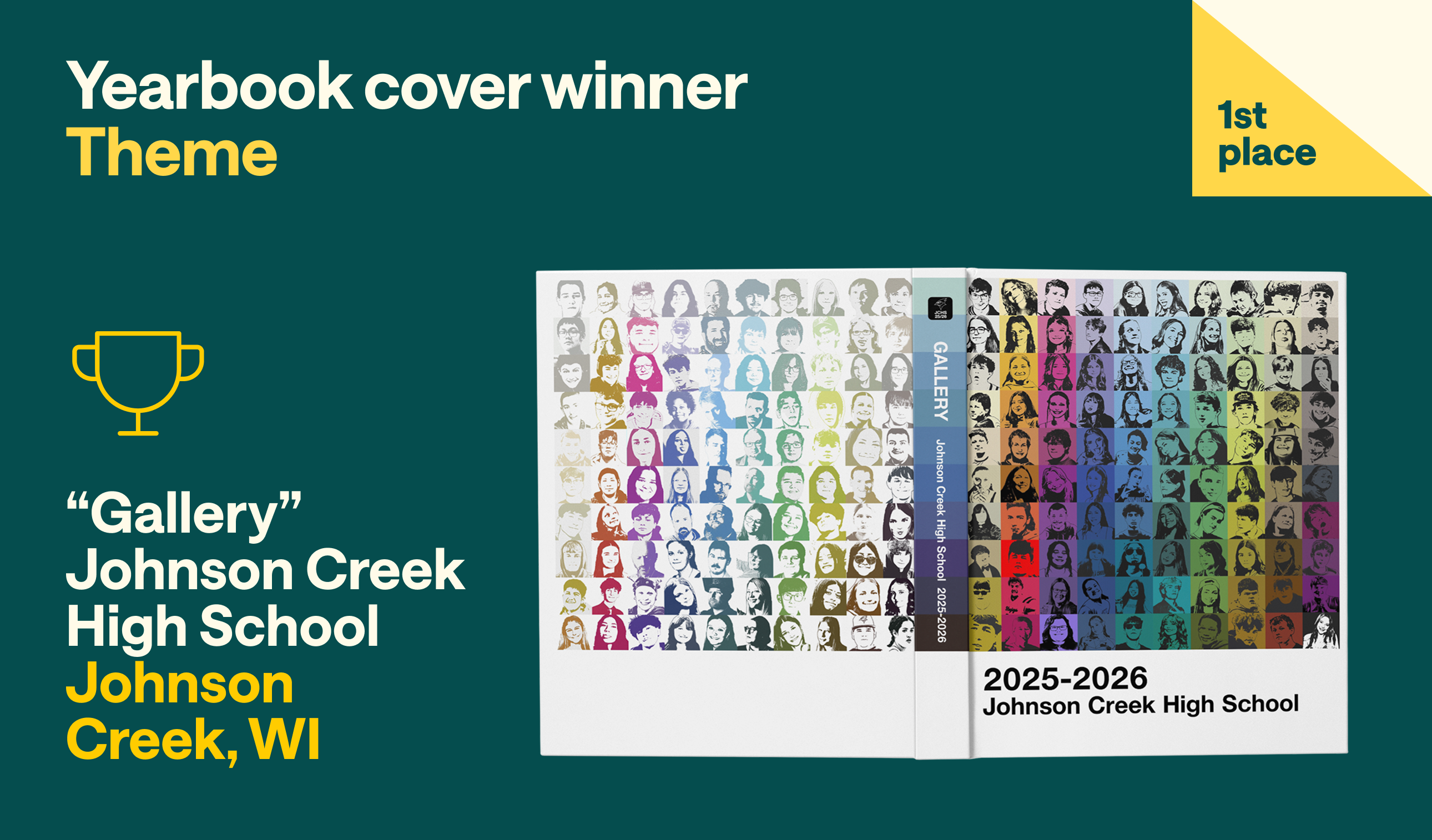
Grand prize winner: “Gallery”
Johnson Creek High School, Johnson Creek, WI
What impressed the judges wasn’t just the technical execution: it was the discipline.
Cover designer, junior Sophia Lawrence, created 200 images by hand. The yearbook team snapped the portraits of students and staff. Lawrence used Photoshop to convert each into a negative image and used the theme color palette to create the front, and reversing the image to create the panels on the back.
The cover features every student and full-time teacher in the school. It took four months and 600 layers to create.
Their “Gallery” theme became more than a visual concept: it became the framework for the whole book. They curated content and framed the highlights of the school year in an exhibition of the Johnson Creek Community.
Each grade had a class color defined by the theme. Standouts, club photos, and athletic features repeated the familiar color chip aesthetic. The yearbook team demonstrated consistency throughout the yearbook and showed advanced photo editing skills without the use of AI.
The bold color creates energy and is balanced by high-contrast black-and-white images, making students the focal point.
Adviser Ryan Molley’s 11 yearbook students do not meet together in a formal class period or club session. Instead, they independently work in his classroom while he teaches his core subjects.
“We are making artifacts that are beautiful,” Molley said.
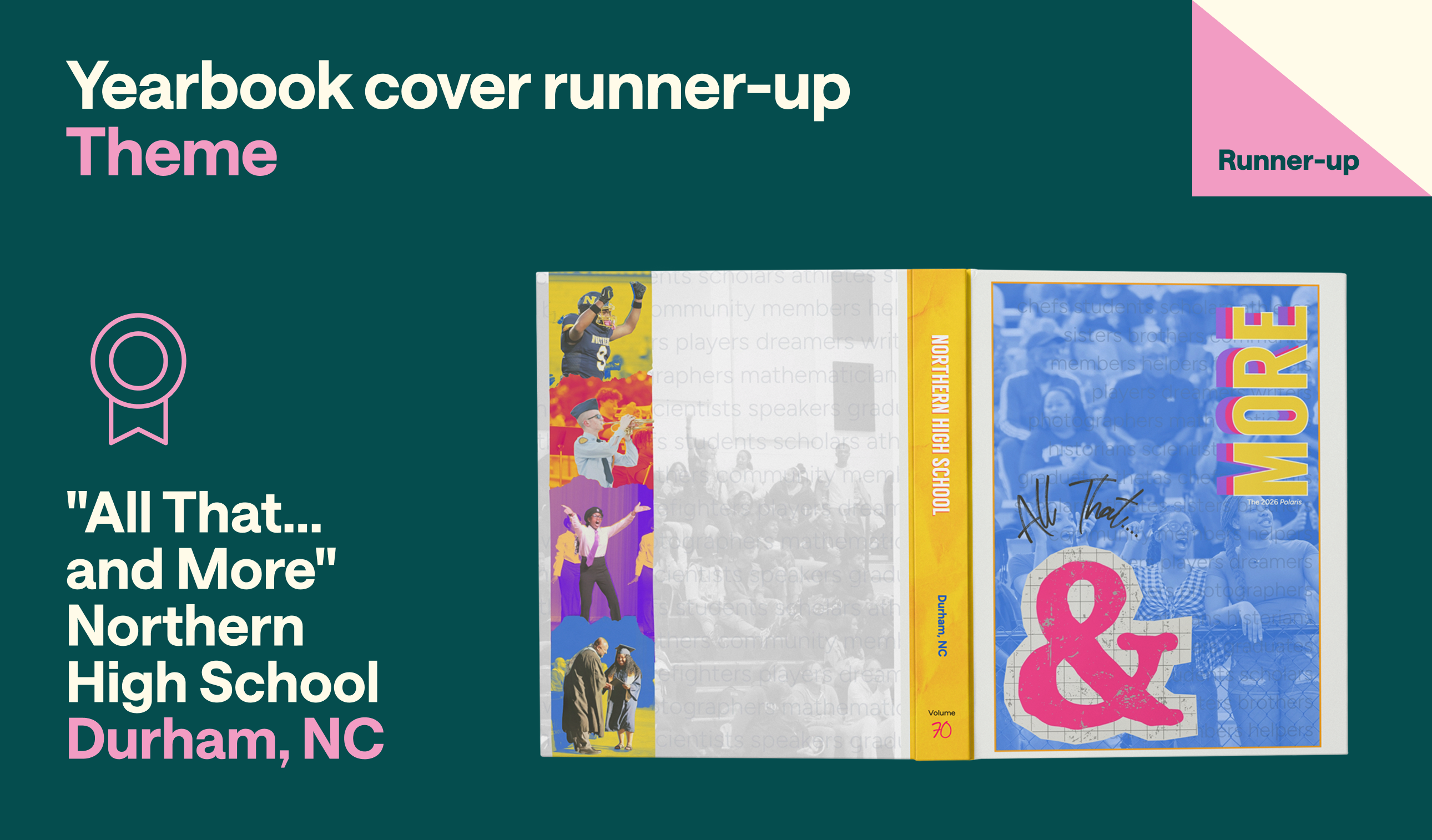
Runner up: “All That & More”
Northern High School, Durham, NC
The use of color gives an initial “wow” moment, followed by clear design hierarchy and visual treatment of the ampersand. By using the faces of the students who fill the pages, the cover doesn’t depend on stock images or Treering graphics. The bold text functions like a challenge: open the book and we’ll prove it. (And they totally did!)
Adviser Lauren Casteen and her editorial board brainstormed over the summer to capture the story of who really walks the halls. In their audit, they realized they are surrounded by “Renaissance people” because their classmates are involved in many activities
The four students on the back cover embody this: an every season athlete, an ROTC student in the band, a sorority sister-slash-soccerplayer-slash-dancer, and an early grad.
What a still image does not show: UV gloss text with some of the identities Northern High students hold, such as Theta, historian, graduate, and brother.

The question became: how do we show that? The short answer: maximalism.
They wanted every page to feel full, and Casteen pushed them to have boundaries and remember design rules still need to have a place. The editors responded by researching the maximalist movement and creating a style guide to support “over the top” graphics and layering. They employed
- White space
- Limited color palette
- Clean fonts (exceptions: headlines and stylized pull quotes)
- Textures, fills, and mixed media
Northern High School's cover is proof that successful yearbook design isn't determined by budget, software, or equipment. It's determined by vision, creativity, and the willingness to keep refining an idea until it works. The result is a cover that feels both ambitious and deeply personal.
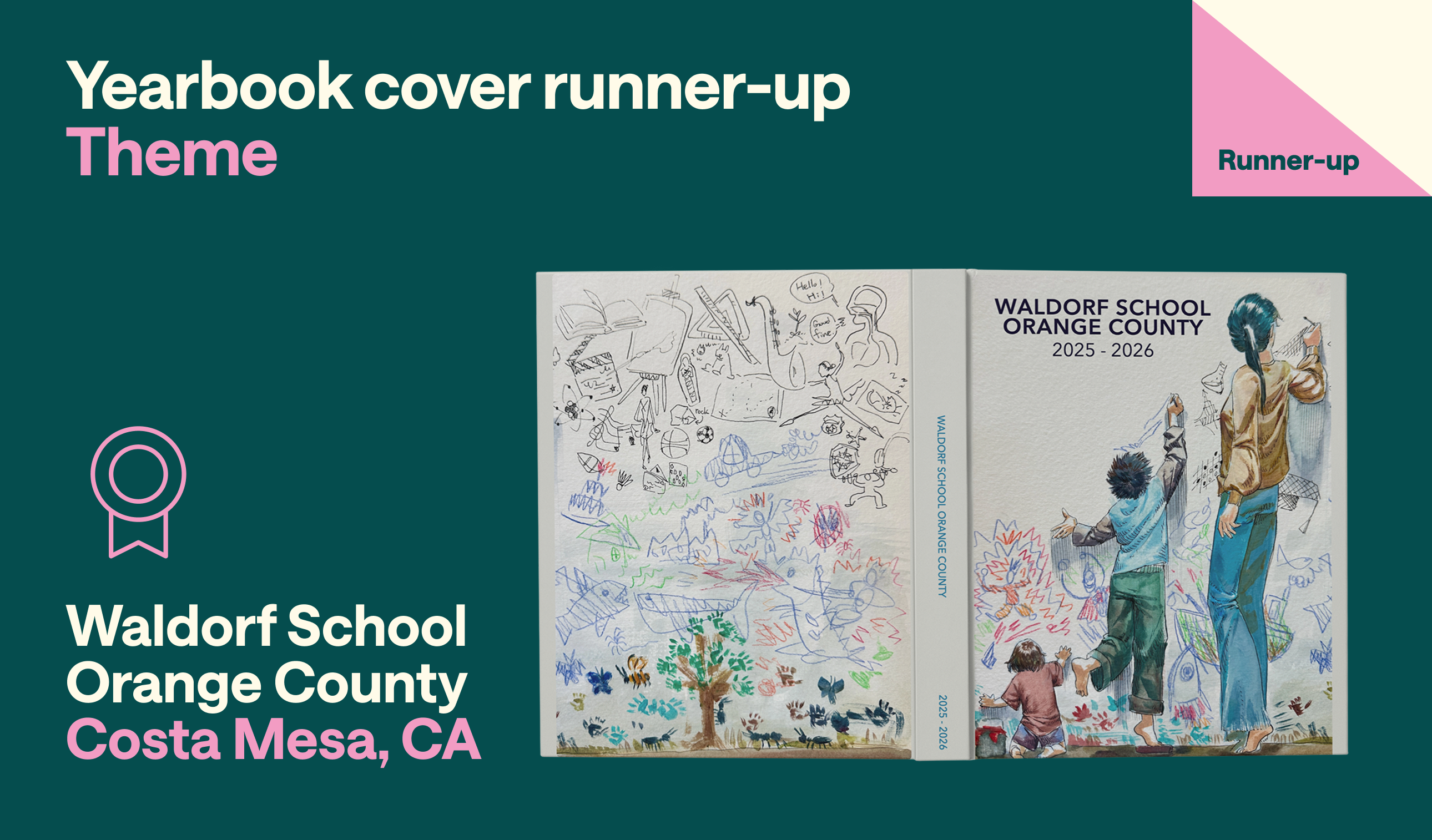
Runner up: “Untitled”
Waldorf School Orange County, Costa Mesa, CA
Senior Doris Zhang created the cover depicting a toddler, child, and teen doodling. There are fingerpaintings, eraser marks, and hatching. On the first few passes, the judges thought it was a composite of multiple classes rather than a single student’s creation.
We were never so glad to be wrong.
“[Zhang’s] concept, design, and execution of the 2025–26 yearbook cover stand as a shining example of the lasting impact that artistic integration can have on a student’s confidence, vision, and relationship with art,” adviser Kathy Christian said.
The spreads within begin with parent-infant classes, progress through elementary, middle, and high school grades, and finish with the faculty guides. The organization itself mirrors the journey Zhang began in the cover.
“Yearbook is a visual showcase of what students do, not what students do best,” said Christian, who recognizes the challenges of creating a yearbook for an audience that runs from infancy to 12th grade.
The yearbook editorial team completes eight passes of the book to ensure students are in their class portraits and have their art showcased. Their goal is to showcase the journey of progression over time.
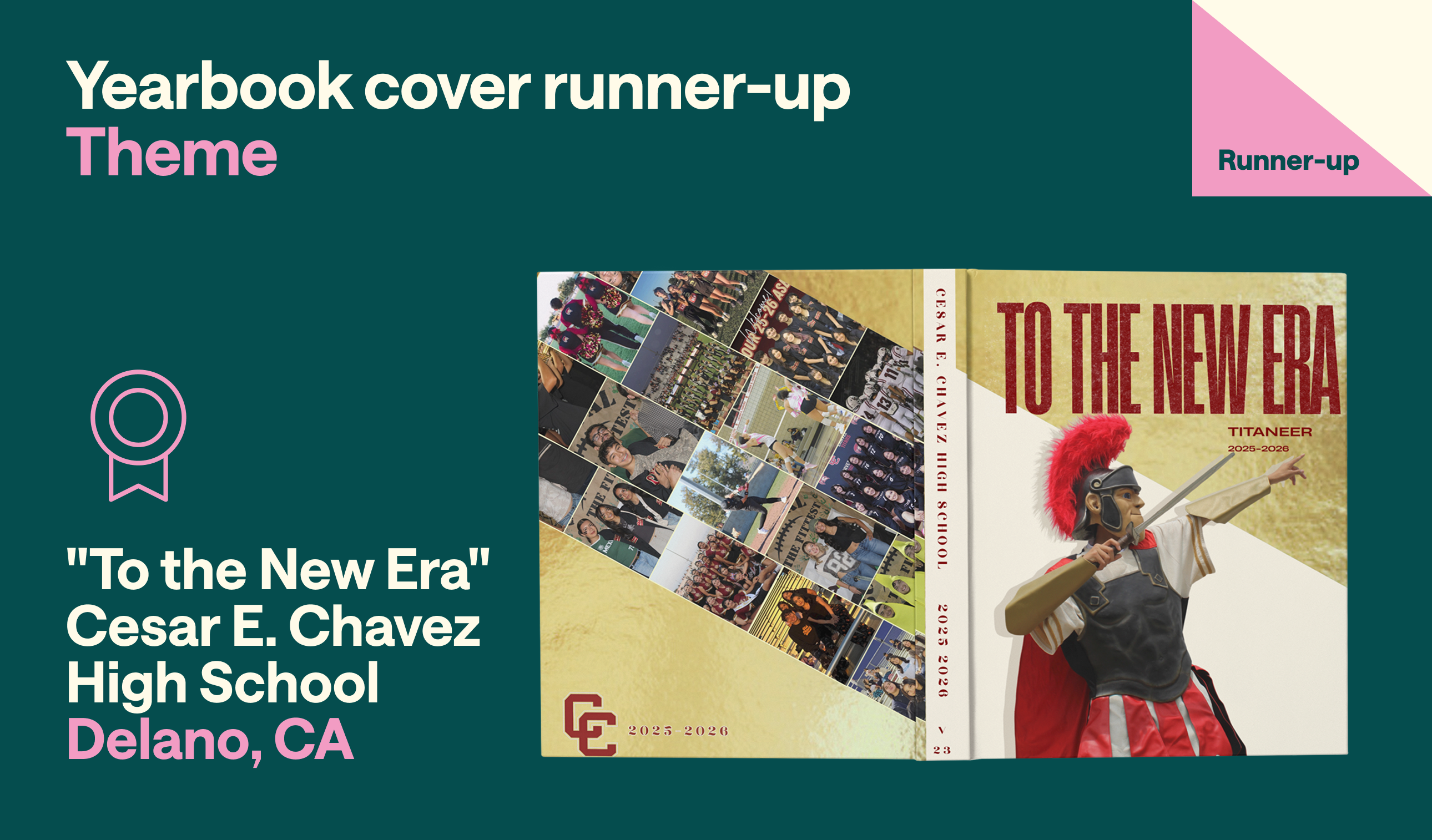
Runner up: “To the New Era”
Cesar E. Chavez High School, Delano, CA
Adviser Karen Hernandez said she didn’t know where to begin as a first-year adviser. The students came up with theme projects which they pitched to the class. The top four went on a Google Form and “To the New Era” won.
At the time, the concept was difficult to develop. They wrestled with it and eventually changed the yearbook theme to “Off Script,” which visually had a 90s ‘zine aesthetic.
Mid-year, they got the news: the school will be renamed for the 2026-2027 school year. Again, they pivoted. The news became the catalyst for their original theme: now, there was a story.
“This is a send off,” Hernandez said.
The winning cover submission was the fourth iteration, and featured some of the original concepts, including the mascot photo which a yearbook student took.
Judges praised cover elements such as the diagonal bar projecting upward movement, school colors, and the gold leaf, all of which appear throughout the book—even the index is stunning and connects to the cover.
Visually, it was a celebration of Cesar Chavez High School’s community. And that won’t change with a new name.
As you can see, the judges consistently rewarded authentic representation over decoration and storytelling over trends. We are proud to showcase the top entries to represent the creativity, passion, and student-centered connections that preserve school memories beyond a social feed.
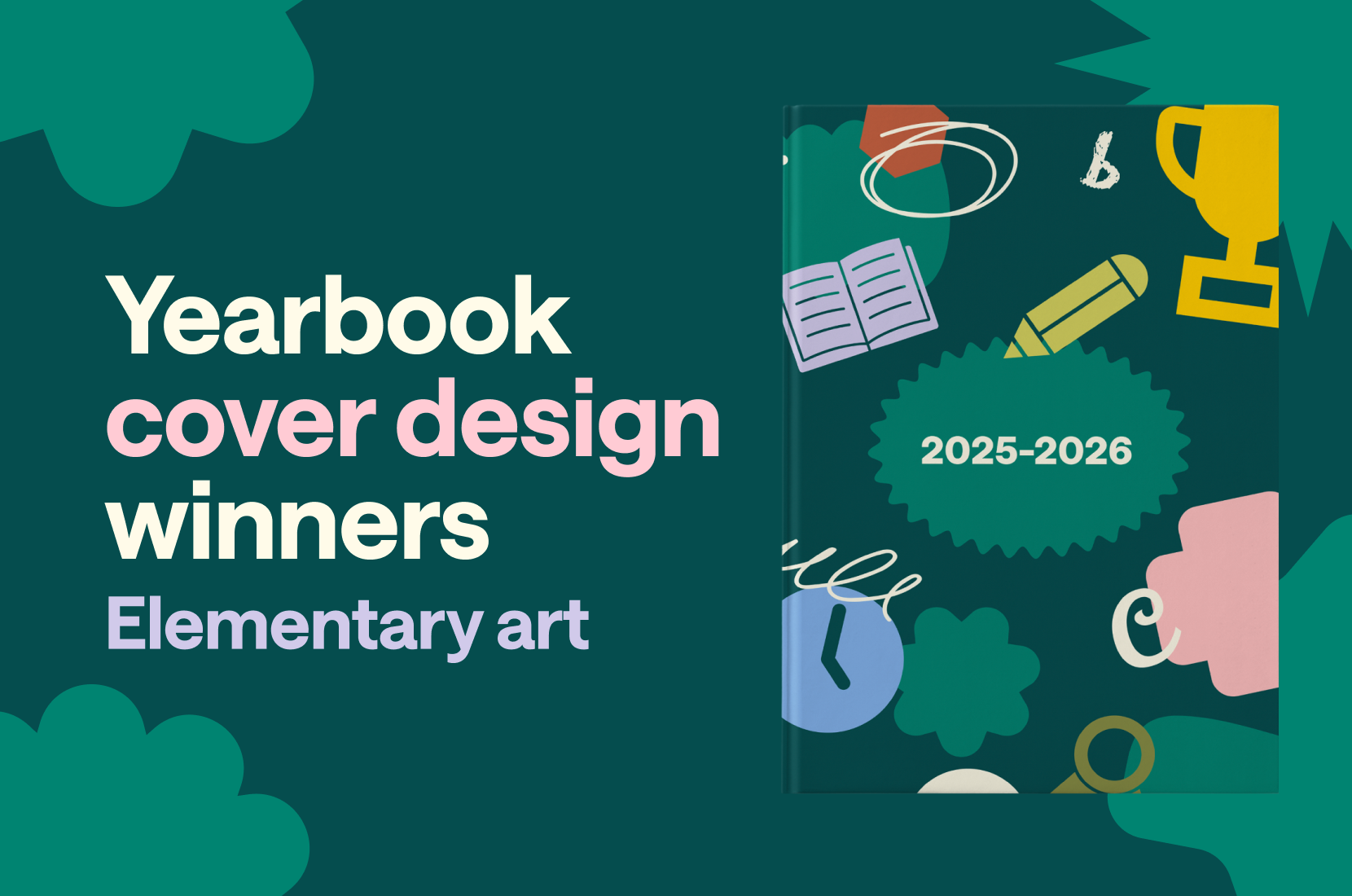
Elementary Student Art Cover Winners from the 2026 Treering Yearbook Design Contest
Treering’s annual design contest celebrates the creativity, storytelling, and talent that make yearbooks meaningful. This year, we combined the contests for cover, custom pages, and spreads, creating our biggest challenge yet.
Your response was incredible.
Three groups of judges evaluated over 1,000 entries from parents and school leaders for
- Design quality
- Storytelling
- Visual impact
- Relevance to content
In the elementary student art category, the top entries were not over-designed. Quickly a trend in the top designs emerged: collaborative pieces celebrated community. These handcrafted images felt human and truly owned by the students they reflect.
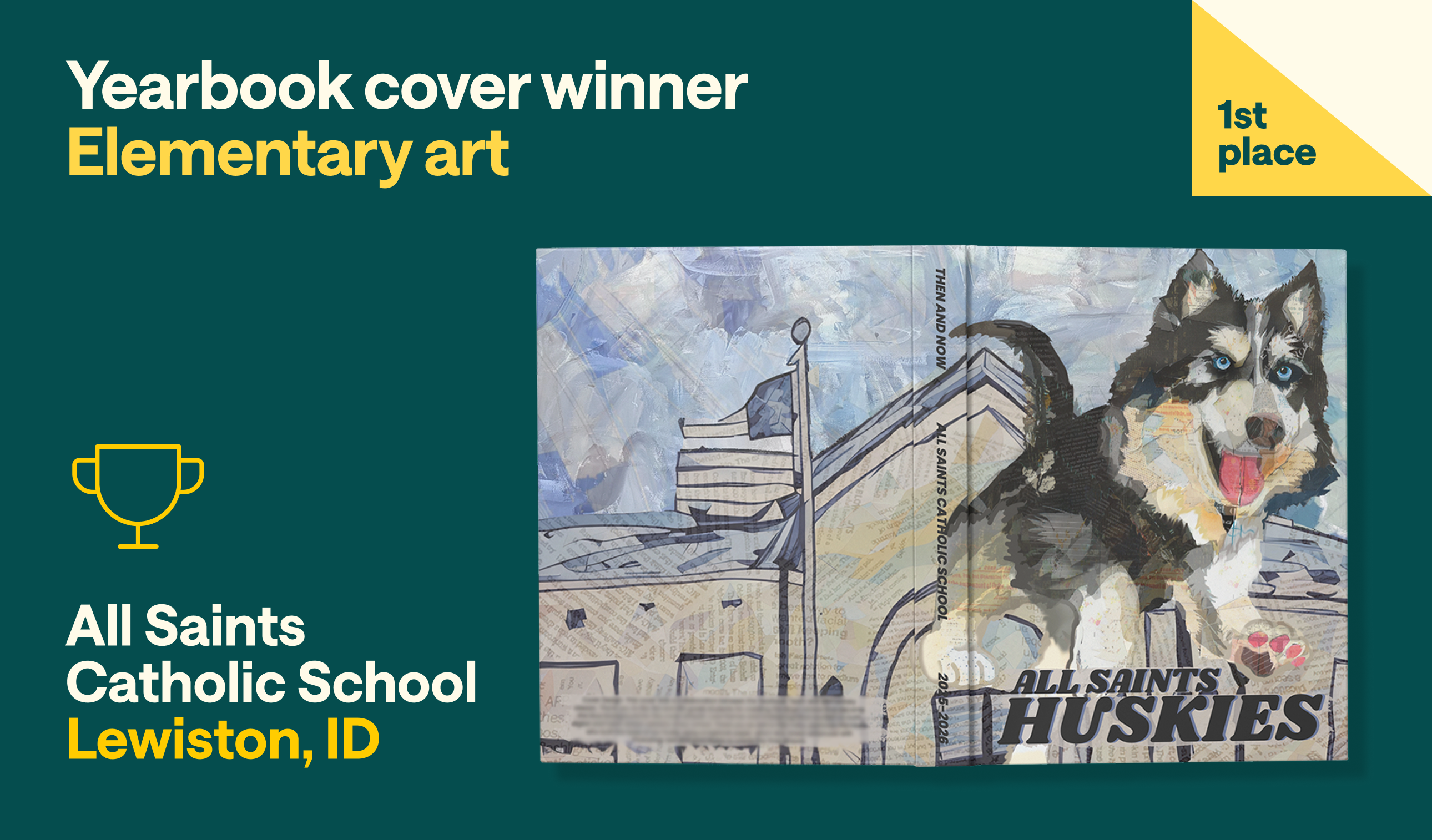
Grand prize winner: All Saints Catholic School, Lewiston, ID
Zooming in on this cover, the judges drew a collective breath. Brush strokes, raw paper edges, newsprint, and layer upon layer emerged from the collective art piece that formed All Saints Catholic School’s cover.
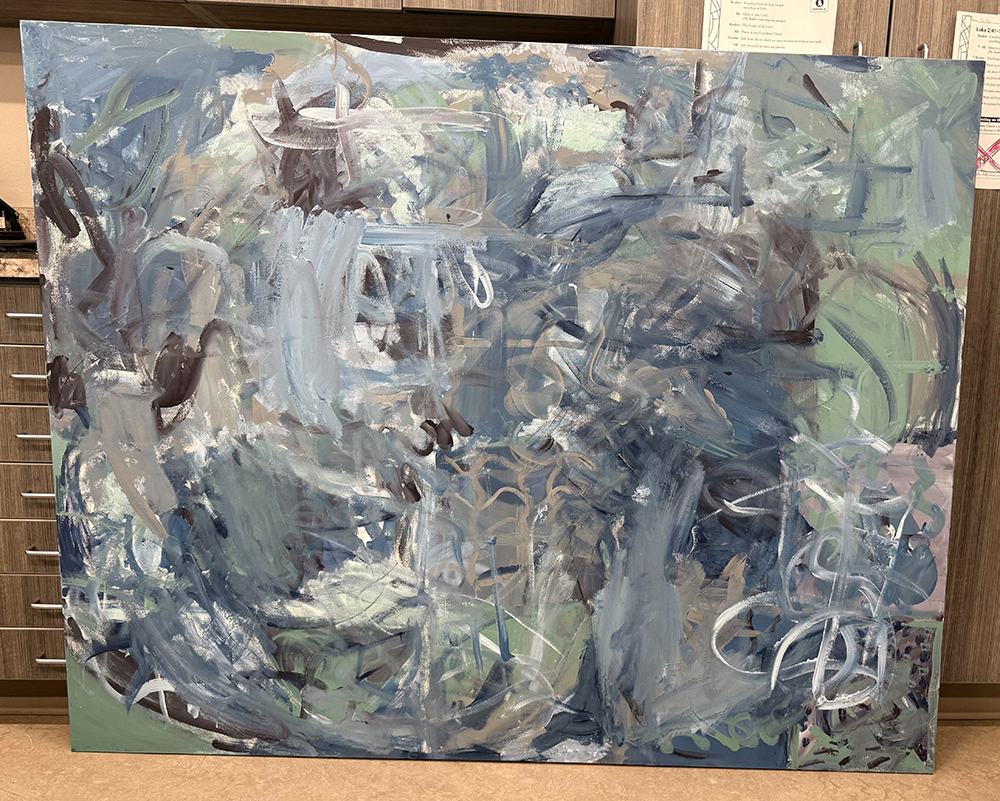
The base
Third and fourth graders created the colorful canvas for the foundation.
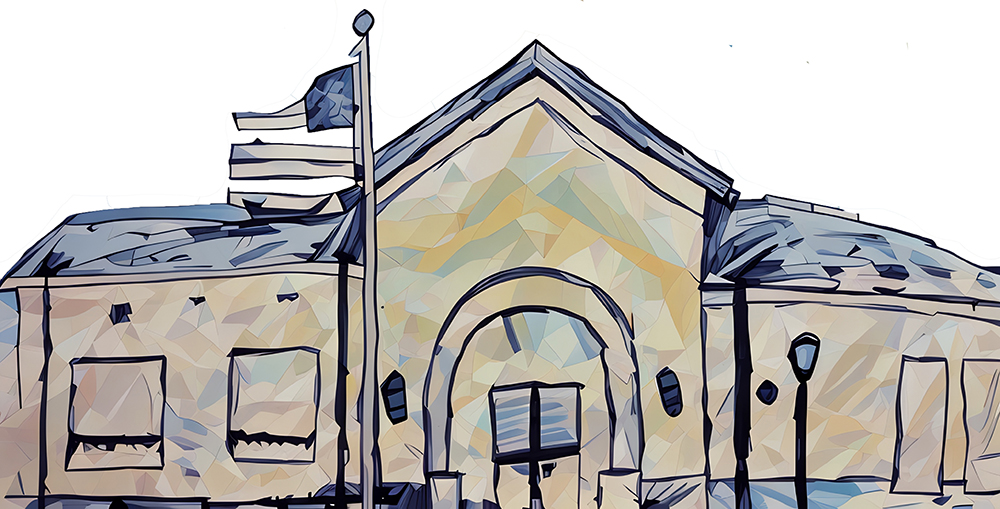
Students also drew an outline of the school, which they cleaned up and painted using digital tools.
The mascot
Others studied different pictures of a husky and created an outline using what they deemed ideal qualities (tail curvature, facial expression, etc.).
“Pattern pieces were created out of the different areas of color, then the students cut out an excessive amount of individual pieces of scrapbooking paper to create the base colors on the dog,” adviser Miranda Green, who is also the school’s art teacher, said.
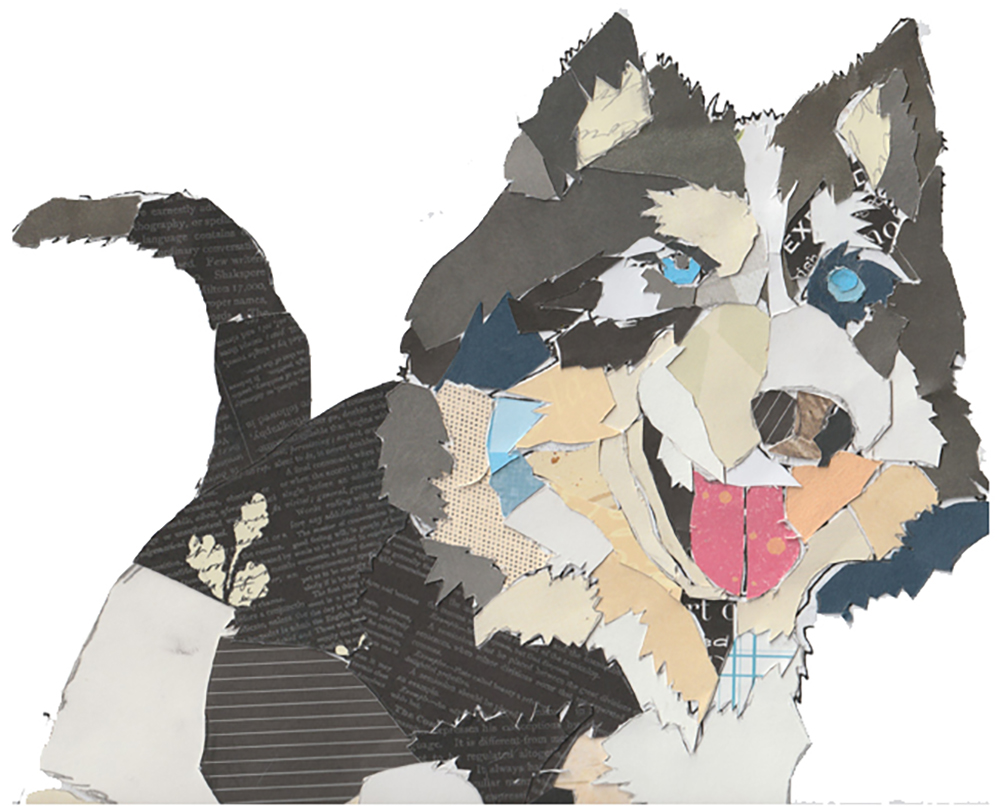
Green and the students compiled the pieces (one paint, one digital, one torn paper) using Photoshop, uploaded the artwork to Treering, and added the copy.
The result is a blended mixed media piece of art deeply rooted in school identity.
.png)
Runner up: Burgin Elementary School, Arlington, TX
Judges called out “extreme inclusion,” “it celebrates how students see themselves,” and “coverage goals” when they saw the 350 hand-drawn self-portraits on the cover of Burgin Elementary’s cover. You can see PK artists, 6th graders, and every student in between. The grid system kept it from being overwhelming and the variation of color and style kept us looking.
“I wanted it to be all about the kids,” yearbook coordinator Cole Perrine said.
Perrine has every yearbook from his school days. He couldn’t wait to start the tradition with his daughter for her first year of school. Then he discovered that Burgin’s PTA hadn’t had a yearbook for a decade. And they didn’t have a PTA. So he helped initiate both.
As a professional in film and television, he emphasized the craft over using AI to create the yearbook. His yearbook club students created their own layouts. They took candid photos and worked with staff to crowdsource submissions.
Perrine also worked with the art teacher to develop the school-wide portrait project. Using their yearbook portraits as inspiration, students developed their own, which Perrine scanned in batches of 10, downloaded them to his computer, and repeated. His wife created the layout for both cover panels.
The students celebrated with the first-ever yearbook signing party on campus.
“Yearbook was everything when I was in school,” Perrine said.
Runner up: Maplebrook Elementary, Naperville, IL
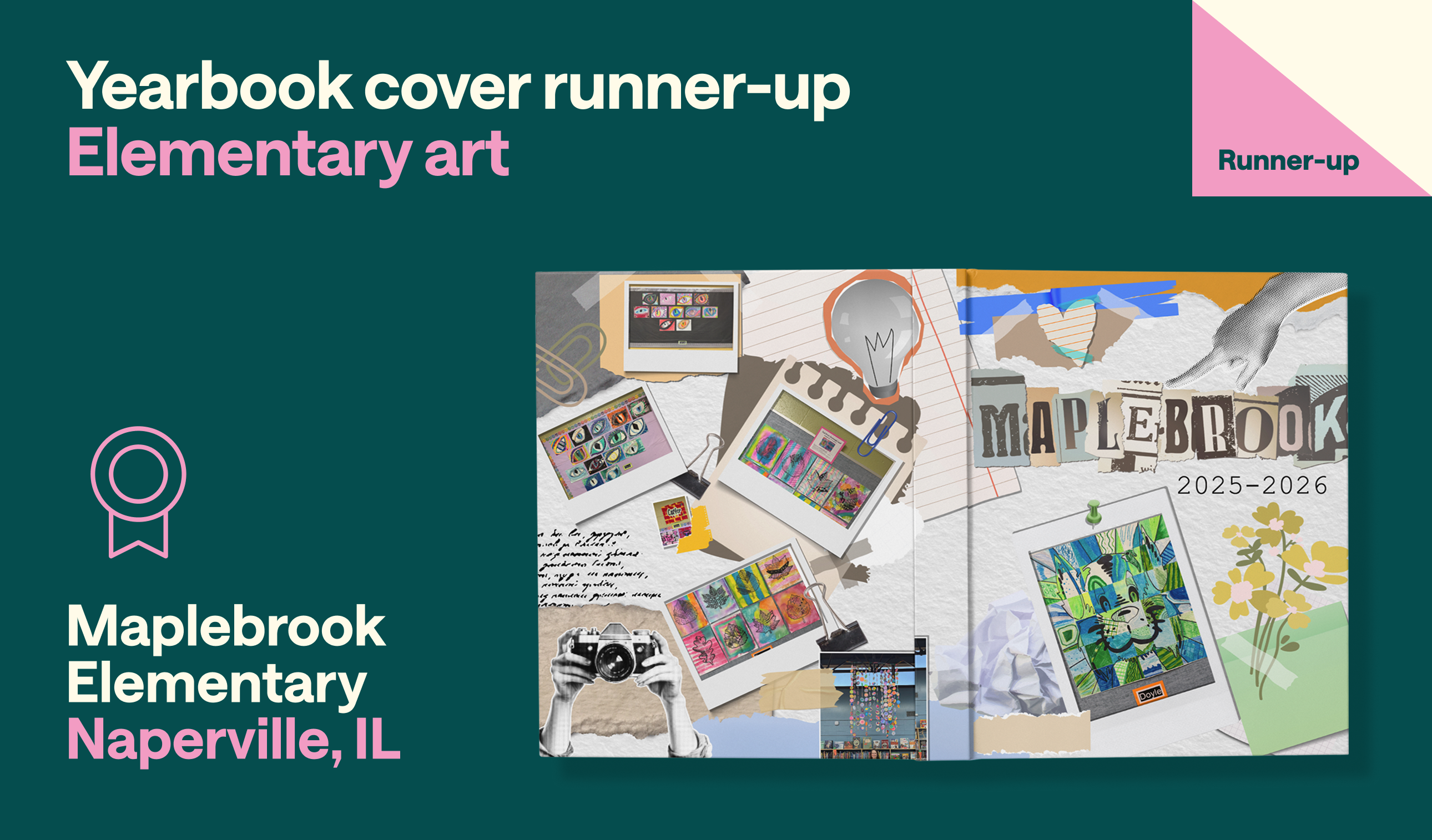
Looking at the cover, it feels like a yearbook about making things. Yearbook coordinator Emily Tonon adapted the Treering “Collage” theme kit to reflect students’ creativity by featuring classroom artifacts, sketches, artwork, and the art instructor who inspired it all.
It feels like a vision board. Layers, mixed media graphics, and multiple focal points invite visual exploration. Maplebrook Elementary’s cover told us they are a school that values creativity, experimentation, and student expression.
Inspired by art installations on campus, Tonon brought them in the book. Beyond the cover, she created student art features throughout the yearbook as another way to cover students and the work they do.
Runner up: Olita Elementary, La Habra, CA
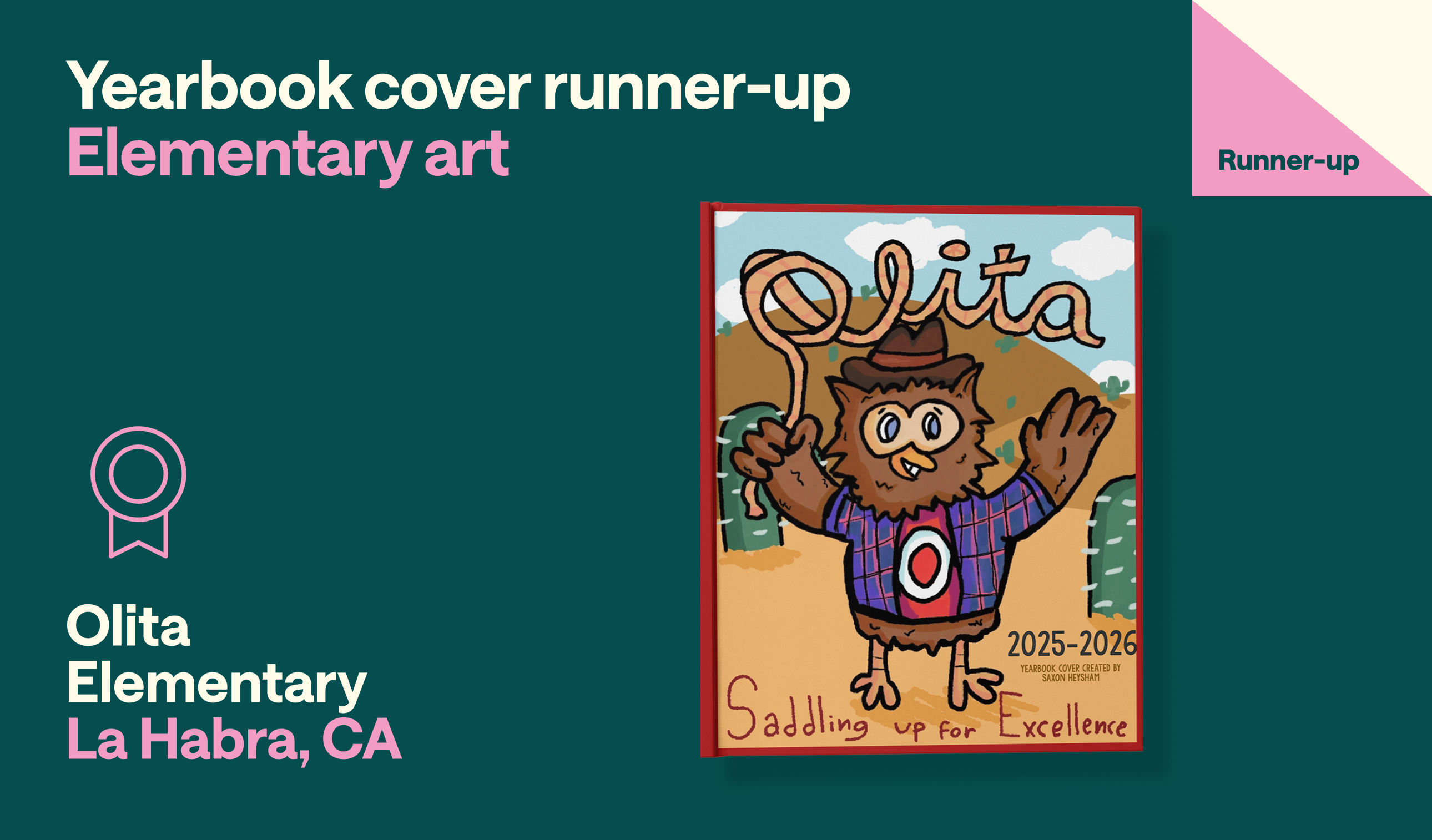
Judges fell in love with the details: shadows from the cacti, spines in all directions, use of negative space, strong readability, and “Olita” spelled out with the lasso. The student creator hand drew the art on his iPad.
PTA president Christie Fisher continued the 25-year tradition of having 6th graders create the cover art. The submissions are blind judged and they must include Ollie the owl and the school year theme, “Saddle up for excellence.”
This cover conveys the school's personality and demonstrates student ownership.
As you can see, the judges consistently rewarded authentic representation over decoration and storytelling over trends. We are proud to showcase the top entries to represent the creativity, passion, and student-centered connections that preserve school memories beyond a social feed.

2026 Treering Yearbook Design Contest Official Rules
The annual Treering Yearbook Design Contests celebrate creativity from schools and families across the country. This year, we’ve made them one celebration of storytelling and design. Advisers, parents, and school staff can submit their best yearbook covers, spreads, and custom pages for a chance to win prizes, be featured in Treering’s 2026 Idea Book, and inspire schools across the country.
Whether you're designing the official school yearbook and aiming for a show-stopping cover, or you're a family creating custom pages that capture your student's unique memories, this is your opportunity to share your best work.
Your designs deserve to be seen.
Contest entry period: May 18-June 3, 2026 at 11:59 pm PT
Incomplete entries and those submitted after the deadline will not be considered.
Eligibility
- Entrants must be 18 years or older
- Must be affiliated with a US Treering school for the 2025–2026 school year
- No purchase is necessary to enter
Categories
Cover design
Submit your school’s yearbook cover design in one of the following:
- Elementary art
- Theme or visual identity
- School spirit
Limit: one cover submission per school
Yearbook spread
Submit a two-page yearbook spread that showcases your design work
Custom pages
Submit a two-page custom page spread created for an individual student
How to enter
To enter the yearbook design contest:
- Go to the entry form at contests.treering.com
- Select your category: cover, spread, or custom pages
- Upload your design
- Complete the submission form
All entries must include:
- A clear screenshot of the design in JPEG or PNG format
- Optional description of your design
- Treering school name
- Contact information
- Entrant role
- Confirmation of age (18+)
- Acknowledge the media release
Incomplete entries will not be accepted
Submission requirements
- Designs must be created for the 2025–2026 school year
- Images must clearly show the full design:
- Cover: front and back
- Spread: two-facing pages
- Custom pages: two-facing pages
- Entries must be submitted through the official contest form
Judging and selection
A panel of graphic designers, yearbook advisers, and marketing pros will review all eligible submissions.
Entries will be evaluated based on:
- Design quality
- Storytelling
- Visual impact
- Relevance to content
Judging will occur in multiple rounds, including shortlist selection and final review.
Winners
Six grand prize winners will be selected in the following categories:
- Cover design:
- Elementary art (1)
- Theme or visual identity (1)
- School spirit (1)
- Yearbook spread
- K-8 (1)
- K-12, high school (1)
- Custom pages (1)
Additional finalists will be recognized
.png)
Prizes
Cover and spread grand prize winners (school)
- DSLR camera (grand prize)
- 10 free yearbooks for 26-27
- Feature in Treering’s 2026 Idea Book
- Spotlight on Treering blog and social channels
Cover and spread grand runners-up (school)
- $50 gift card
- 3 free yearbooks for 26-27
- Feature in Treering’s 2026 Idea Book
Custom pages grand prize winner (family)
- $300 gift card
- Feature in Treering’s 2026 Idea Book
- Spotlight on Treering blog and social channels
Custom pages runners-up (family)
- $50 gift card
- Feature in Treering’s 2026 Idea Book
Winner notification
Winners will be notified via phone and email. Eligibility must be confirmed prior to the formal winner announcement, June 15–21, 2026.
Winners may be required to provide additional materials for promotional use.
Release
By submitting an entry, you confirm you have permission to use all images and content included and grant Treering the right to use your submission, name, and school for marketing purposes. This includes, but is not limited to website/blog, social media, press releases, the Treering Idea Library, and other marketing materials.
This includes use without additional compensation.
Additional terms:
- Treering reserves the right to disqualify incomplete or duplicate entries
- Decisions made by the judging panel are final
- A list of winners and finalists will appear on Treering’s blog during the announcement period, June 15–21, 2026
FAQs
Do I need social media to enter?
No, social media is not required to participate
When is the deadline to enter?
All entries must be submitted by June 3, 2026 at 11:59 pm PT. Incomplete entries will not be considered.
Can I submit more than one entry?
Custom pages and yearbook spreads: yes
Covers: limited to one per school
I designed a yearbook spread, but I’m not 18. Can I still enter?
Students can participate if a parent, adviser, or school staff member submits the entry on their behalf. Prizes for the cover and spread designs will be awarded to the school.
Do I need to purchase a yearbook to enter the design contest?
No purchase is necessary to enter.
When will winners be announced?
Winners will be announced between June 15–21, 2026
How will winners be notified?
Treering’s marketing team will contact the winners by email and phone to confirm eligibility prior to announcing the winners. A complete list of winners will be on Treering’s blog June 21, 2026.
Will other entries be featured?
Yes, top entries may also be featured in the Idea Book, blog, or social media at Treering’s discretion. Please review the media release.
How will I receive my prizes?
Treering will ship the DSLR cameras directly to the school. All gift cards will be sent digitally to the email address on the submission form. Free yearbook codes will be placed in the school’s 26-27 Treering account by Friday, October 2.
Can I edit my submission after I enter?
No, submissions may not be edited after submission. Duplicate submissions will not be considered.

2026 Treering Custom Pages Design Contest Official Rules
The annual Treering Yearbook Design Contests celebrate creativity from schools and families across the country. This year, we’ve made them one celebration of storytelling and design. Parents and school staff can submit their best custom pages for a chance to win prizes, be featured in Treering’s 2026 Idea Book, and inspire families across the country.
If you're a family creating custom pages that capture your student's unique memories, this is your opportunity to share your best work.
Your designs deserve to be seen.
Contest entry period: May 18-June 3, 2026 at 11:59 pm PT
Incomplete entries and those submitted after the deadline will not be considered.
Eligibility
- Entrants must be 18 years or older
- Must be affiliated with a US Treering school for the 2025–2026 school year
- No purchase is necessary to enter
Categories
Custom pages
Submit a two-page custom page spread created for an individual student
How to enter
To enter the yearbook design contest:
- Go to the entry form at contests.treering.com
- Select custom pages as your category
- Upload your design
- Complete the submission form
All entries must include:
- A clear screenshot of the design in JPEG or PNG format
- Optional description of your design
- Treering school name
- Contact information
- Entrant role
- Confirmation of age (18+)
- Acknowledge the media release
Incomplete entries will not be accepted
Submission requirements
- Designs must be created for the 2025–2026 school year
- Custom pages: two-facing pages
- Entries must be submitted through the official contest form
Judging and selection
A panel of graphic designers, yearbook advisers, and marketing pros will review all eligible submissions.
Entries will be evaluated based on:
- Design quality
- Storytelling
- Visual impact
- Relevance to content
Judging will occur in multiple rounds, including shortlist selection and final review.
Winners
There will be one grand prize winner; additional finalists will be recognized
.png)
Prizes
Custom pages grand prize winner (family)
- $300 gift card
- Feature in Treering’s 2026 Idea Book
- Spotlight on Treering blog and social channels
Custom pages runners-up (family)
- $50 gift card
- Feature in Treering’s 2026 Idea Book
Winner notification
Winners will be notified via phone and email. Eligibility must be confirmed prior to the formal winner announcement, June 15–21, 2026. Winners may be required to provide additional materials for promotional use.
Release
By submitting an entry, you confirm you have permission to use all images and content included and grant Treering the right to use your submission, name, and school for marketing purposes. This includes, but is not limited to website/blog, social media, press releases, the Treering Idea Library, and other marketing materials.
This includes use without additional compensation.
Additional terms:
- Treering reserves the right to disqualify incomplete or duplicate entries
- Decisions made by the judging panel are final
- A list of winners and finalists will appear on Treering’s blog during the announcement period, June 15–21, 2026
FAQs
Do I need social media to enter?
No, social media is not required to participate
When is the deadline to enter?
All entries must be submitted by June 3, 2026 at 11:59 pm PT. Incomplete entries will not be considered.
Can I submit more than one entry?
Custom pages: yes
I designed a custom page spread, but I’m not 18. Can I still enter?
Students can participate if a parent submits the entry on their behalf.
Do I need to purchase a yearbook to enter the design contest?
No purchase is necessary to enter.
When will winners be announced?
Winners will be announced between June 15–21, 2026
How will winners be notified?
Treering’s marketing team will contact the winners by email and phone to confirm eligibility prior to announcing the winners. A complete list of winners will be on Treering’s blog June 21, 2026.
Will other entries be featured?
Yes, top entries may also be featured in the Idea Book, blog, or social media at Treering’s discretion. Please review the media release.
How will I receive my prizes?
All gift cards will be sent digitally to the email address on the submission form.
Can I edit my submission after I enter?
No, submissions may not be edited after submission. Duplicate submissions will not be considered.
A yearbook curriculum you'll love teaching
New for the 2025-2026 school year, Treering’s free yearbook curriculum has expanded. From a new adviser handbook to 40 standalone lessons, you can take a recess from yearbook planning stress and put effort into yearbook production.
What’s new?
Teachers updated Treering’s previous curriculum. Another group of teachers tested it. We can confidently say it is teacher-authored and teacher-approved.
Each of the eight student-facing modules has a pacing guide and instructional slides. The pacing guides give you an overview of each module’s five grab-and-go lessons, including teaching resources, should you choose to expand instructional time. If it’s your first time teaching yearbook, the pacing guide also breaks down terminology used and shows connections between lessons.
Each lesson also includes Google Slides with
- Learning target
- Bell ringer
- Interactive lesson with guided student practice
- Exit ticket
You do enough. However, Treering knows no two schools/classes/clubs are alike, so we made our free curriculum 100% editable.
Curriculum FAQs
What’s free?
Everything. Charging extra for resources and support isn’t our thing.
How can I use the curriculum if I only have a club?
The first lesson in each module is a standalone one designed to give you the foundation for teambuilding, theme, design, writing, photography, marketing, and proofing. We recommend club groups do these eight lessons throughout the year.
Is Treering’s curriculum only for new yearbook students?
No, it is for yearbook creators of all backgrounds.
If you have mixed abilities in your class, we suggest:
- Using leaders to teach the first lesson in each module
- Flipping instruction: ask students to go through the slides on their own and be prepared to do the practice session in class
- Use mentor pairs for hands-on activities
Do I have to use Treering to use your yearbook curriculum?
Some theme, design, marketing, and editing lessons involve Treering tools.
Get Treering’s free yearbook curriculum
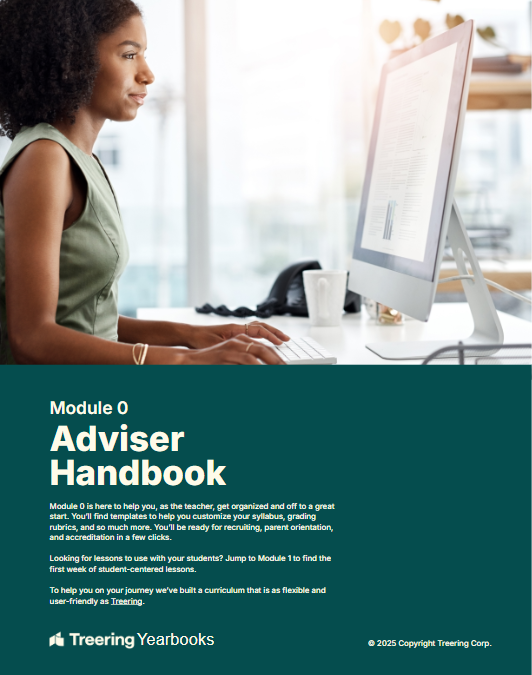
Module 0: adviser handbook
This handbook also contains all your yearbook prep templates: a student application, syllabus, grading rubrics, and staff manuals. It’s formatted vertically for printing.
Access the Adviser Handbook
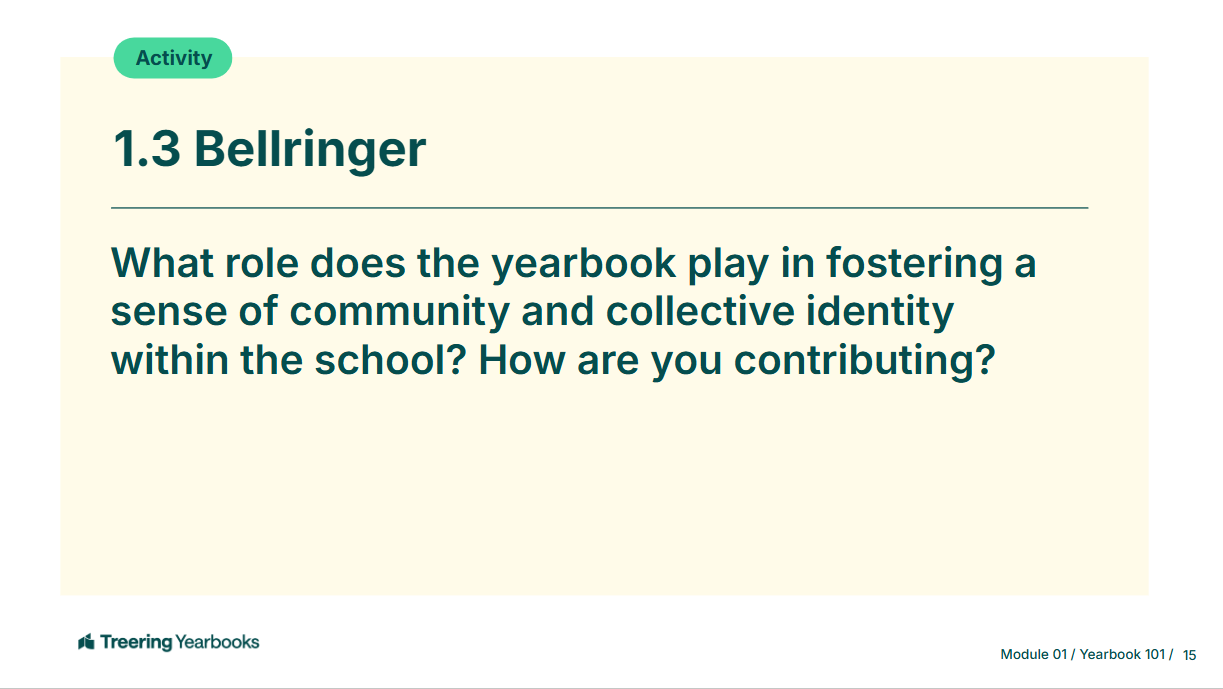
Module 1: yearbook 101
Building a yearbook culture on campus starts with your club or class. Each lesson in Module 1 focuses on team building, establishing clear expectations, and how students can use their individual strengths to build a unified product. This module builds a foundation for the following seven.
Module 1 learning targets:
- Understand the yearbook advisor’s expectations and the class structure
- Locate key information in the syllabus related to grading, expectations, deadlines, and responsibilities.
- Reflect on their personal strengths and interests related to team roles
- Identify and define core yearbook design terms by analyzing real spreads.
- Write specific, measurable, achievable, relevant, and time-bound (SMART) goals for the school year.
Access the Module 1 slides / Module 1 pacing guide
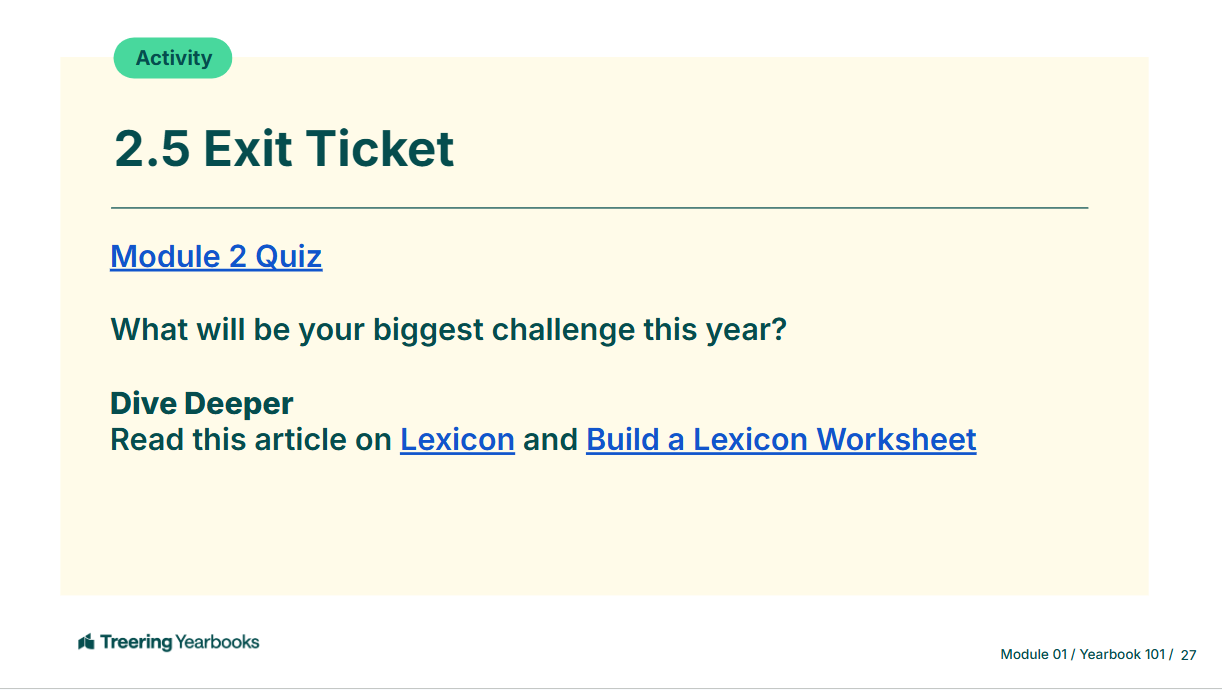
Module 2: kicking off the year(book)
Because yearbooks are part history book and part narrative, Module 2 helps students understand how and why the book they will create will stand the test of time. They will spend time creating a structure for their book and sharing their own stories through an “About Me” yearbook spread.
Module 2 learning targets
- Explain how yearbooks act as historical documents and cultural artifacts.
- Collaborate with peers to build a cohesive and well-organized ladder.
- Understand where and how to store content throughout the school year.
- Use yearbook vocabulary in context while giving and receiving peer feedback.
- Determine the central theme or message being communicated through advertisements.
Access the Module 2 slides / Module 2 pacing guide
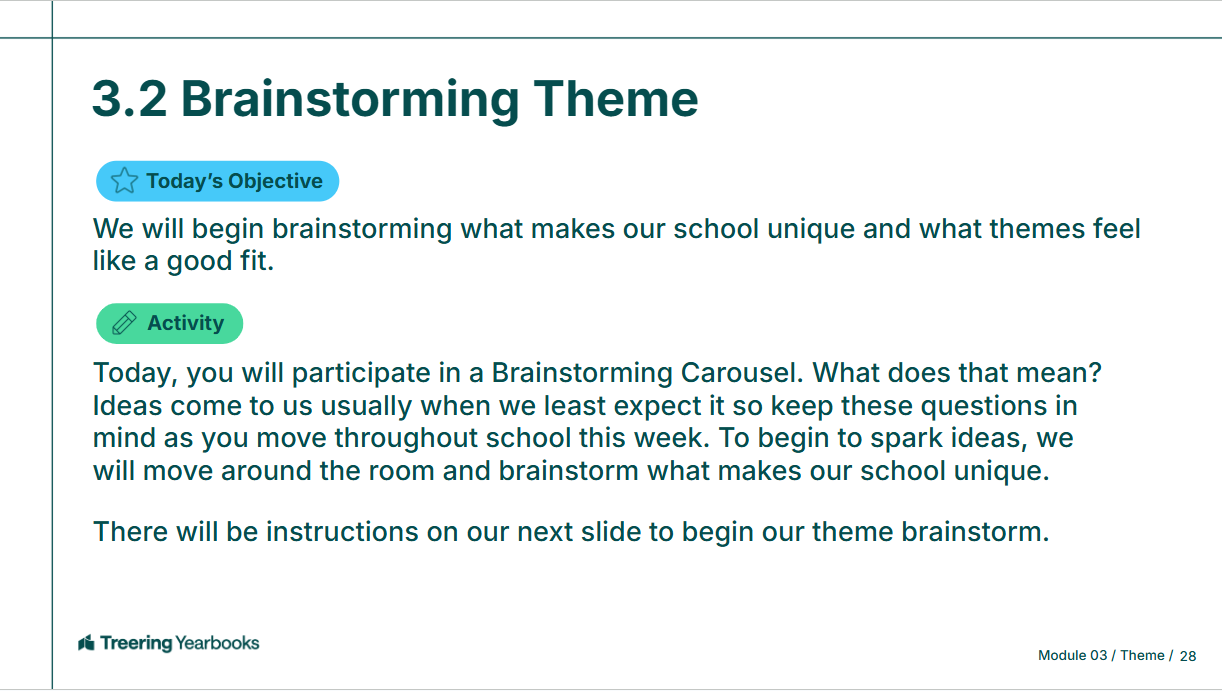
Module 3: theme
Theme is more than just a visual concept, and Module 3 will help you and your yearbook team create one that looks, sounds, and feels like the story of their year.
Module 3 learning targets
- Understand the purpose and components of a yearbook theme.
- Collaboratively brainstorm relevant and original theme ideas.
- Connect theme ideas to the student body and school year.
- Explore the tone, personality, and voice of themes in a creative way.
- Create a plan to apply the theme across content areas.
Access the Module 3 slides / Module 3 pacing guide
Module 4: design
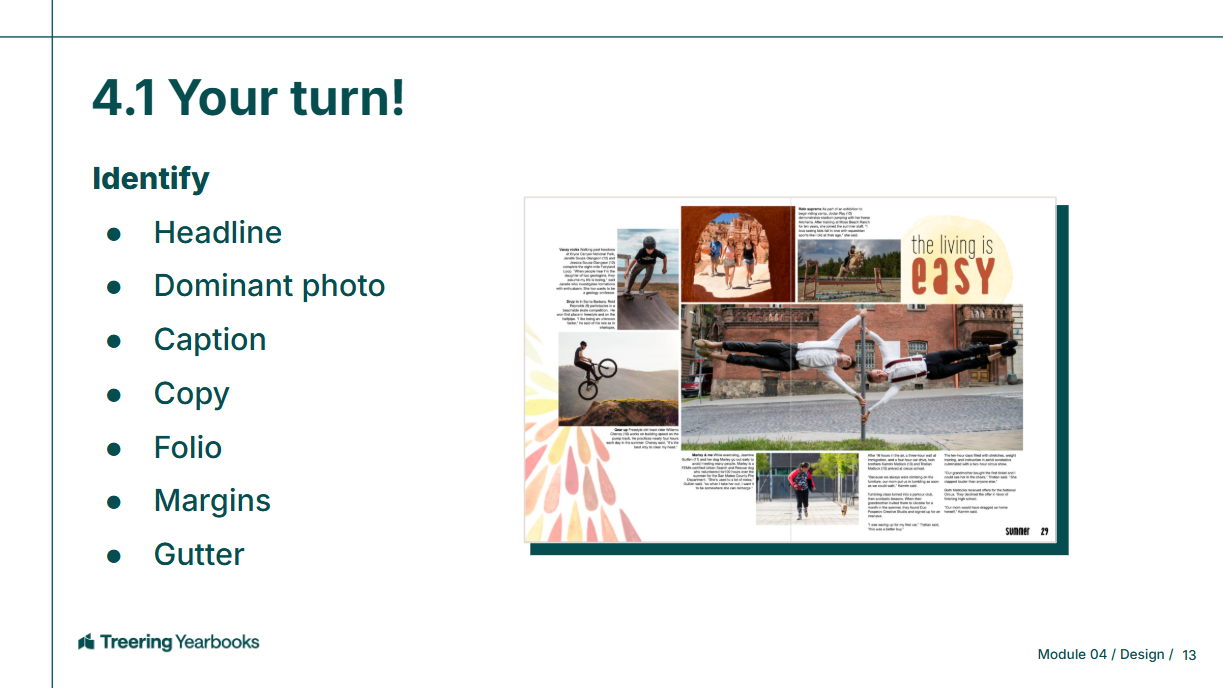
Building upon the theme developed in Module 3, Module 4 is all about bringing that theme to life and learning how to design yearbook pages that guide the reader on a visual journey. Intentional design is the core of this module.
Module 4 learning targets
- Identify the building blocks of design.
- Use Treering’s design tools to create a yearbook spread.
- Create a color palette to express the yearbook theme’s tone and personality.
- Explain the impact of font family, size, weight, and contrast in yearbook design.
- Create text styles to support the visual theme.
- Identify and apply principles of design hierarchy by organizing visual elements (text, images, and white space) on a yearbook spread to guide the reader’s attention effectively and create visual flow.
Access the Module 4 slides / Module 4 pacing guide
Module 5: writing
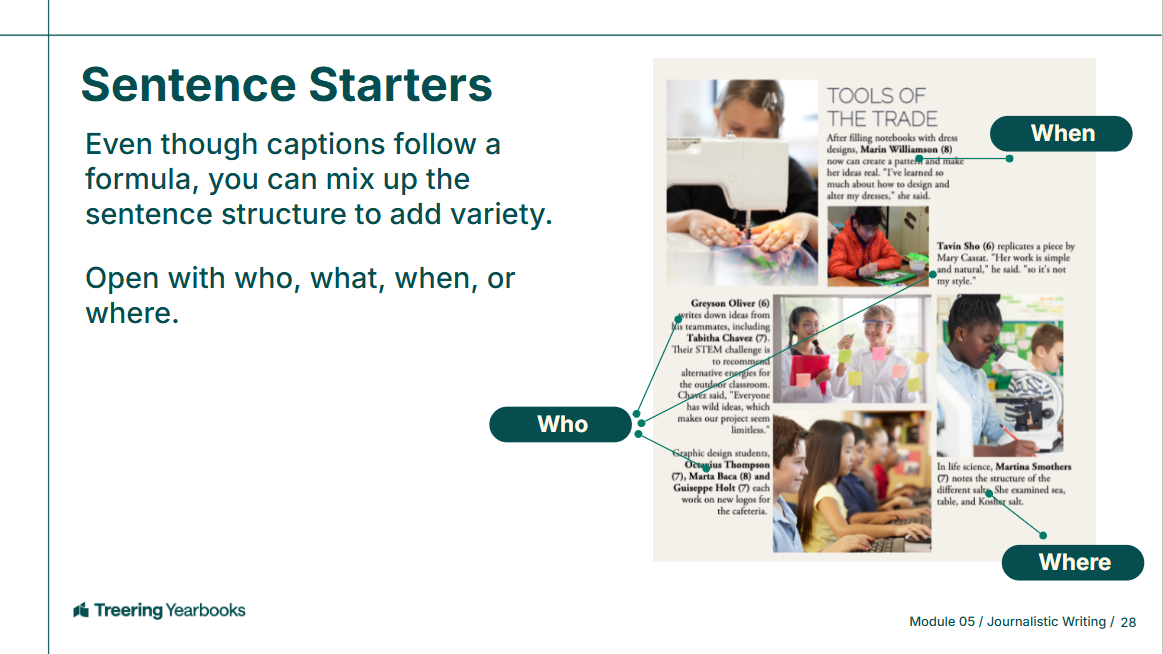
Many times, students tell us they don’t want to add copy to the yearbook because “no one reads it.” Captions, stories, and pull quotes add to the visual story. These voices provide the context, insider information, and even names for your photos.
They are worthy of pursuit.
Module 5 learning targets:
- Identify the different forms of captions: ident, summary, and expanded.
- Examine photographs to identify key information to craft summary and expanded captions.
- Define the five common topics.
- Structure an interview.
- Synthesize and interview by writing body copy and captions.
Access the Module 5 slides / Module 5 pacing guide
Module 6: photography
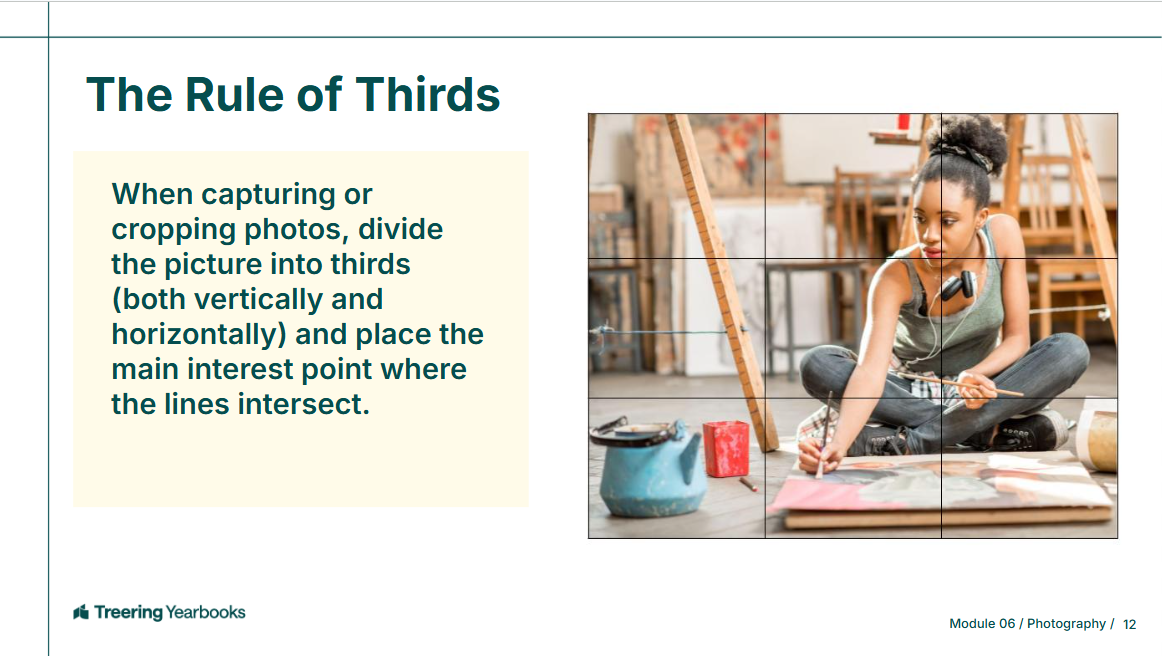
Transform an ordinary photo into an extraordinary visual story through hands-on activities and real-world applications. With your class, explore how angles and lighting and exposure settings can drastically alter a photo’s impact on a yearbook spread.
Module 6 learning targets:
- Identify the composition elements of a photo and evaluate.
- Photograph a subject using six angles.
- Compose an image using natural and artificial light sources.
- Recall the three parts of the exposure triangle and how they work together.
- Use Treering tools to present a photograph to its advantage in a layout.
Access the Module 6 slides / Module 6 pacing guide

Module 7: marketing
Learning targets:
- Identify the components of a marketing campaign.
- Identify, classify, and rank yearbook value props.
- Differentiate marketing messaging based on audience.
- Initiate community participation in yearbook creation.
- Plan milestone celebrations for reaching yearbook creation goals.
Access the Module 7 slides / Module 7 pacing guide

Module 8: proofing
Learning targets:
- Discuss and develop a consistent framework for all copy elements and community-submitted content.
- Review editing guidelines to help catch errors and maintain consistency by reviewing content early and often.
- Identify tools and methods to carefully proof both visual and written elements for accuracy and clarity.
- Use checklists and tools to ensure every page aligns with your yearbook’s design standards.
- Learn to use Treering’s editing tools to establish and maintain clean lines and a polished, professional look.
Access the Module 8 slides / Module 8 pacing guide
Happy New Year from Treering: 2025 was a record-breaking year of creativity
For sixteen years, you’ve trusted Treering to capture and print your school’s memories, and every December, we pause to reflect on what a privilege that truly is. What started as a simple idea (that yearbooks should be easier, more affordable, and more personal) has now grown into a movement powered by editors, teachers, parents, and students who care deeply about preserving their school stories.
This year, that movement reached new heights.

In 2025, Treering helped schools raise $2.9 million, printed our 10 millionth yearbook, and earned a place on the Inc. 5000 list of the fastest-growing companies. But behind every milestone is a more meaningful truth: editors and advisers across the country continue to create smarter, stronger, more student-centered yearbooks. We’re honored to support them every step of the way.
Below is a look back at the innovations, stories, and community moments that shaped Treering’s 16th year plus a peek into what’s coming next.
A creative community that keeps growing (and inspiring us)
Each year, the Treering community grows not only in size but in creativity and confidence. In 2025, our community passed 12 million members, representing schools in Australia, Canada, and the US. Behind every login is someone with a vision: the first-year adviser walking into a new school year, the senior editor rallying a team of ninth graders, the parent volunteer learning design terms for the very first time.

Helping schools raise a remarkable $2.9 million
Fundraising continues to be one of the biggest stress points for schools, and Treering schools love receiving a yearbook check instead of a yearbook bill. By choosing their fundraising amount and adding it to the total cost of the book, schools raised $2.9 million in 2025.
Instead of paying a yearbook invoice, schools are putting real dollars back into their budgets, funding what matters most: field trips, clubs, student journalism programs, arts initiatives, athletic equipment, spirit events, classroom resources, and yearbooks for students in need.
A major milestone: Treering’s 10 millionth book
Some milestones call for a moment of awe — and this was one of them.
This winter, we printed Treering’s 10 millionth yearbook. That number represents millions of stories, academic achievements, halftime huddles, first days of school, senior dedications, hallway friendships, and portraits of students who will one day show the book to their own kids.
For us, it also represents innovation: we’re one of the only companies able to produce fully custom books, with custom pages for every student, in under three weeks. When every book is uniquely theirs, yearbooks celebrate students in a way that is meaningful for them.
How we supported editors this year
If we had to choose a theme for 2025, it would be editor empowerment. Every enhancement we built this year was designed to support the people who power the book, especially advisers and student editors who juggle deadlines, clubs, homework, coverage gaps, and the joyful yet chaotic reality of school life.
Your feedback, questions, wish lists, and creativity drive every improvement we make.
1. Faster, smoother, more confident onboarding
This year, we expanded the Treering onboarding experience. Whether you were learning the platform for the first time or returning after a few years away, Welcome Walkthrough calls with the Community Advocate Team and communications from L1FT helped create a clear roadmap for setting up the book, customizing pages, inviting editors, collecting photos, and aligning your timeline.
Many schools reported that this shifted their entire experience, turning what once felt intimidating into a confident first step.
2. A bigger, better year of contests
We heard your requests for contests that spotlight page design talent and also inspire creativity during key moments of the production cycle.
This year, Treering contests included:
- Inaugural cover contest
- Instagram photo contests
- Parent and editor design contests
- Seasonal challenges that aligned with design checkpoints via pop-up giveaways on Instagram and Facebook

3. Camp Yearbook: our annual two-day summer conference
Camp Yearbook launched in 2024 as a way to help advisers and editors start strong before school even started. Schools joined us for two days of themed workshops, live design sessions, team-building exercises, and planning challenges.
It quickly became one of our highest-rated programs of the year, and many schools left with their theme locked, their ladder built, and their editors trained before the first bell rang.
4. Updated yearbook curriculum
A team of former classroom teacher-slash-yearbook advisers and a group of current yearbook advisers completed a complete overhaul of Treering’s free yearbook curriculum. The updated curriculum is now grab-and-go. Instead of long, one-size-fits-all sessions that advisers have to divide and support, lessons are now broken into focused segments that can be taught in short class periods, advisory blocks, club meetings, or asynchronous settings.
Each module now includes five lessons with
- A clear objective based on Common Core and/or CTE Career Ready standards
- Bite-sized instruction that fits real bell schedules
- Bell ringers, student-facing slides, activities, and exit tickets
- Practical examples pulled directly from real Treering schools’ books
- Action steps students can apply immediately to their pages
This structure made it easier for advisers to meet students where they are, whether they’re first-time editors learning the basics or experienced leaders ready to push design and storytelling further.

5. More real-life examples shown across our socials
Editors asked for clearer examples of real pages created by real schools. This year, we overhauled our social strategy to prioritize:
- Regular showcases of elementary, middle, and high school spreads and cover ideas
- Behind-the-scenes process videos
- How to use Treering’s complete themes
- “Fix this spread” mini-tutorials on TikTok
- Real portraits and coverage examples to inspire editors
- Creating a private Facebook group for advisers to support and inspire one another
This shift helped new advisers see what’s possible. It also helped experienced teams level up their work.
Looking ahead: what to expect in 2026
As we enter year seventeen, we’re more committed than ever to supporting editors with tools, training, and community spaces that make yearbook creation easier:
Superior support as you design, market, and distribute your best yearbook yet
- Clear how-to guides for marketing your book
- Expanded training calendars
- New resources for student leadership teams and editing workflows
Yearbook Club workshops
Our virtual Yearbook Club is expanding to twice-monthly sessions, including:
- Design labs
- Editor leadership coaching
- Photo submission strategies
- Theme development deep dives
- Marketing walkthroughs
- Distribution planning in real time
Print ready to delivery: still three weeks or less
We remain committed to fast, predictable, high-quality printing.
Templates editors have asked for
Yearbook advisers met with the design team for three focus groups to evaluate this year’s crop of themes and predict design trends for 25-26. Based on early feedback, to support schools that want clean, easy, plug-and-go options, we are releasing ten theme packages in fall.
Treering theme packages will continue to be complete, coordinated yearbook design systems with a customizable cover, matching interior layouts, 100+ coordinating graphics, and a curated color palette. They’re designed to make yearbooking easier and faster.
Thank you for an amazing year
Thank you for another year of creativity, passion, and partnership. Whether you built your first book this year or your eleventh, whether you’re a student editor, a parent volunteer, a journalism adviser, or a school leader, your work matters, and we’re honored to support it.
Sixteen years in, and every new year feels like the most meaningful one yet. The number of books we’ve printed, the awards we’ve received, the millions raised matter. What matters most is the trust you place in us to help you preserve the moments that shape your school communities.
We wish you joy, rest, and inspiration this holiday season. We cannot wait to create with you in 2026.
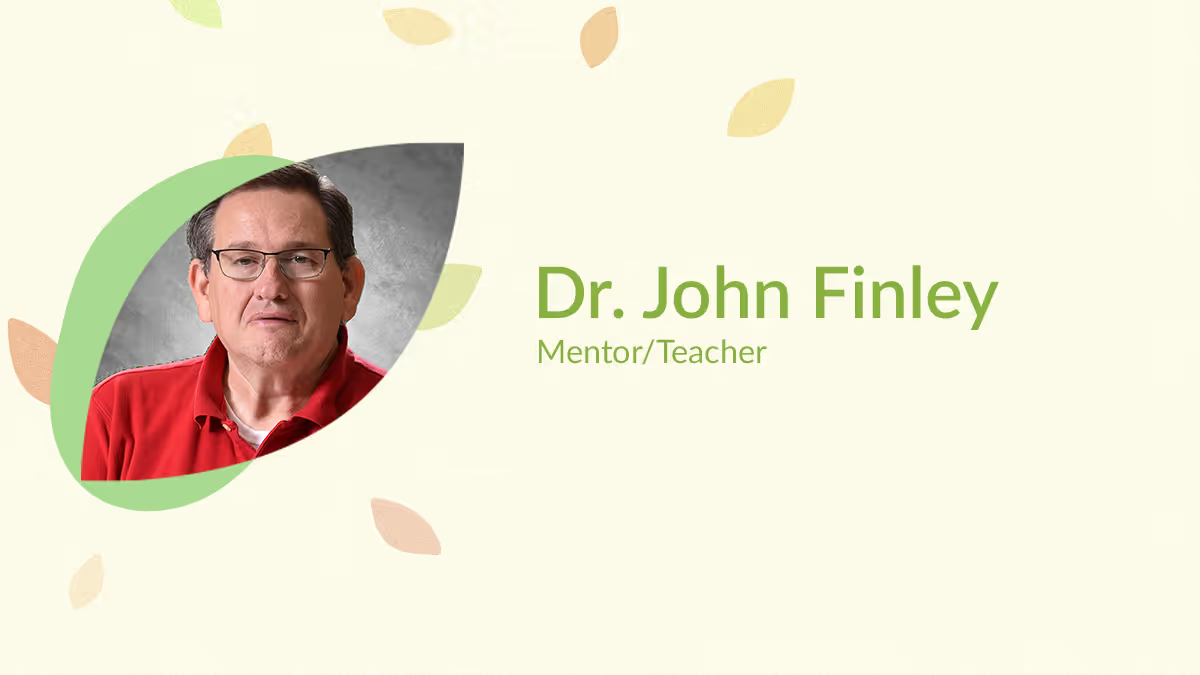
Yearbook hero Dr. John Finley builds a legacy
Treering Yearbook Heroes is a monthly feature focusing on yearbook adviser tips and tricks.
Schools like Kate D Smith DAR High School of Grant, AL, build momentum by gathering motivated teachers and students to gather photos, draft content, and design spreads. Dr. John Finley is a business teacher for grades 9-12 at Kate D Smith DAR High School and also spearheads the creation of the yearbook with the assistance of his students. With his background in videography and photography, he inherited the role of yearbook sponsor and this is his second year leading the development of student journalists.
What’s unique about John’s role within yearbook is that he really lets the students run with creativity and he owns his role of adviser. This allows the students to take near-complete ownership of the book, learn how to utilize the Treering app, and motivates them to be confident in their abilities in the classroom.
John and part of his yearbook team were excited to share how they plan to develop the yearbook this year, which will include KDS DAR School’s 2021 Dedication Day, which occurs every October.
What’s something unique about the school’s yearbook team?
Last year, we started a mentoring program where the seniors who have experience with yearbook get to share their knowledge with junior and sophomore students. We realized that the students who were involved with yearbook were primarily juniors, so when they eventually graduated, we didn’t have students on board who could guide the underclassmen.
So now, all seniors and juniors involved with yearbook choose one younger student to teach everything they know about yearbook. And then when the seniors graduate, the younger students are prepared to take the reins. A lot of the “yearbook” training actually takes place at events when students are taking photos for the yearbook. It’s a great hands-on opportunity for upperclassmen to show and explain their process for securing content for the yearbook.

What stands out to you from last year’s book, which was created during the pandemic?
What stood out to me the most was the theme, A Year Like No Other. This really rang true to everyone at school be it teachers, students or administrative staff. The yearbook team took the approach that they were writing the first history book of the pandemic for our entire community. The book was dedicated to the memory of those we lost and the families that were affected.
What was nice about using the Treering app, especially during this time, was that it gave us the ability to share photos right into the folder in an easy way. Because we weren’t able to be together in person, we were able to get a variety of photos from at-home learning. We’re currently back in the classroom this year, but a lot of lessons were learned last year—some heartbreaking—that were beautifully expressed in the book.
What’s something unique your school adds to the yearbook?
Dedication Day is a two-day event set to take place October 21-22 that only takes place in our community and is something we always take time to cover in the yearbook because of how much it means to all of us at the school. This will be the 97th year the school celebrates the patriotic education made possible by the Daughters of the Revolution (DAR). During the Dedication Day celebration, DAR chapters from across the U.S. travel to Grant, AL, and pledge funds for school projects.
In the yearbook this year, for example, we’ll capture photos of the two-day event highlighting student musical performances, speakers and the overall history of the DAR and how they began their mission in 1922 to build schools in remote areas of the U.S. KDS DAR School, which sits atop Gunter Mountain in Grant, was selected based on the will and dedication of the Daughters of the Revolution to give the people in this area a path to education.

The one layout template you need
Yearbook coverage ideas might be our favorite topic: brainstorming ways to represent more students, resulting in a more authentic narrative of the school year. It could also mean more photos, interviews, and work for you. After a colleague shared Kingsbury Country Day School’s yearbook, a lightbulb went off. Yearbook coordinator Kara-Jane LaVoisne created the perfect layout that includes over 60 students, highlighting their impact and participation in school events.
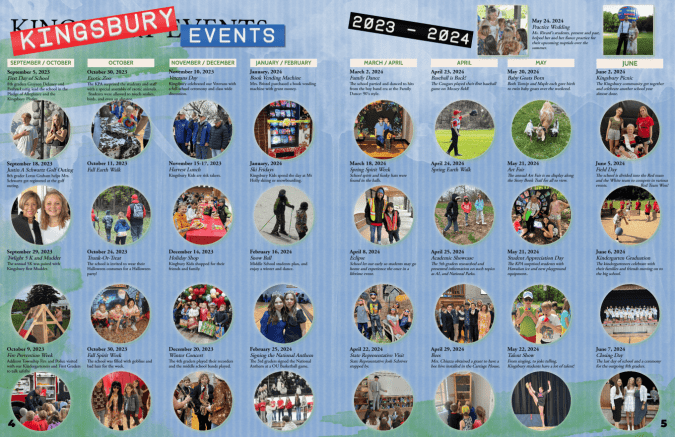
Why we love this template
This spread packs a punch because it covers a large span of time in little space. It covers 24% of the school across two pages. It showcases events that would not be covered elsewhere. This template is also well-designed: it’s clean and has multiple reader entry points.
Home for smaller events
Oftentimes, we have several photos that don’t fit on a larger spread. This is especially common in books that do not take advantage of modular design. LaVoisne took advantage of those moments to create a means to include them.
Versatility
While LaVoisne used this template for a school-specific year-in-review, you can use it once per section or season. For example:
- Fall, winter, and spring PTA or ASB events
- An overview of the sports seasons
- Semester rundown of student life
If you’re feeling ambitious and have the content, an hour-by-hour review of a major school event such as the talent show or homecoming weekend could be a showstopper spread for your yearbook.

What’s most important: your yearbook team celebrates the people in your campus community. This layout is just one way to cover more students in your yearbook. For more creative yearbook coverage inspiration, check out:

2025 Treering Memories contest rules
Parents, your 2025 memories deserve the spotlight! Share your funniest, proudest, or sweetest moment and tag @TreeringCorp and use #Treering2025Memories for a chance to win something for you.
Three winners will take home a one spa day, treat box, or a week of coffee on us. Your memory might be featured on our page!
Eligibility
- U.S. parents or legal guardians, 18+
- No purchase necessary
Treering Memories contest entry period
- Starts Monday, December 15, 2025, at 8:00 AM PT
- Ends Thursday, December 18, 2025, at 11:59 PM PT
Steps to enter
- Follow @TreeringCorp on Instagram
- Share a funny, proud, or sweet memory from 2025 on your Feed or Story (must be a public profile to be visible)
- Tag @TreeringCorp
- Use #Treering2025Memories
Winner selection and notification
Treering's social team will select the winners based on creativity and originality. Winners will be announced on Instagram during contest week.
Prizes
Three winners total will receive one of the following:
- Spa / self-care gift card
- Delivered treat box
- Coffee for the week
Release
By sharing your photo, you have verified the approval of the original photographer and anyone pictured, and you approve Treering to use your name, write-up, and school name for any marketing purposes, including but not limited to treering.com, social media, and mass media.
Additional information
- Content must be appropriate for all audiences
Contest not sponsored by Instagram

Essential yearbooking gear
One of the top questions we see in yearbook adviser and yearbook coordinator Facebook groups involves yearbook gear such as cameras and organizational supplies. Using a combination of funds from budget money, yearbook fundraiser proceeds, or a grant, you can build a media room that achieves your goals.
This list is not meant to be comprehensive, rather a smattering of options. Tailor your shopping list to match your program’s goals as well as your population. Do you really want your elementary yearbook club students passing around a $2000 camera? Conversely, should your competitive high school team aim for a Pacemaker with just point and shoot cameras?
Cameras
Camera bodies
The camera body, or box, is where half the magic happens: the shutter release, mirror, viewfinder, and controls live on the box on a digital single-lens reflex (DSLR) camera; see mirrorless camera below if your head is going to explode. Your yearbook photographers will control the settings here.
Purchasing a camera kit from a big box store or online may seem like a great deal. The lenses that accompany those kits usually aren’t “fast” enough to take photographs in the gym or an auditorium when the light tends to be tricky.
A used camera kit from a resale website is always an option for schools looking to buy yearbook equipment with limited funds. Save the money for a fabulous lens that will help you get the sharp images you want. Most bodies built in the last 5-10 years will have the ISO, autofocus, and shutter speed capabilities you need, even for those frustrating low-light gym photographs.
Some great beginning boxes are:
- Canon Rebel
- Nikon D3500
Mirrorless cameras
Being lighter, and a potentially less expensive investment, mirrorless cameras are slowly replacing some DSLRs in yearbook classrooms. Mirrorless cameras will help emerging photographers because there isn’t as much gear to tote and they can look less intimidating.
Highly recommended mirrorless cameras:
- Canon R6
- Nikon Z6
Lenses
In many cases, investing in a lens aka glass will be more critical than a body. If all your school’s sports are outside, then the lenses that come in your kit will be perfect. If you photograph volleyball and basketball in a gym or musicals in a dark auditorium, then you are going to want a lens that can use the full ISO, aperture, and shutter speed range of your box. When buying any lens, make sure it marries your box. There are some off-brand lens brands such as Sigma and Tokina that are less expensive than their Canon and Nikon counterparts.
Two lenses to have
- 35-70mm f/2.8
- 50mm f/1.8 (more on the nifty fifty below)
Nifty fifty
If you add anything to your cart this year, make it a 50mm lens. The depth of field and low-light capabilities you have are what the young people deem clut


Lens cleaning essentials
Each camera bag in your yearbook program should contain a camel hair cleaning brush.
Pro tip: A pencil eraser is a great tool to keep in each camera bag to clean the battery connectors.
Photography essentials
Lens filter
These aren’t the photo-destroying filters your social apps provide, but screw-on glass filters for camera lenses. Use this circular filter for cutting glare and reducing light specifically with outdoor photos. Before setting out on a yearbook assignment with a polarized filter, take some time to play with it. Because it increases color saturation and cuts bright spots, it takes some time to learn.
Reflector
Reflectors, next to the nifty fifty, are one of the best, inexpensive photography items your yearbook program can use. They help you control light for outside portraits (think of fun ways you can take those pull quote pics up a notch) and also maximize limited lighting when doing studio shoots. A fun, and less traditional way to use a reflector is as a background.
Ring light
With mini ring lights being a cell phone staple in the early stages of influencers, pros have used the big ones for years. Ring lights surround your subject and eliminate most shadows over which three-point lighting enthusiasts geek out. (If you play around with your ring light and reflector, you can simulate the three-point look!) They make eyes pop.
The best ring lights are at least 18”, and they come with both warm and cool light settings as well as a dimmer. Some tripods also have cell phone and tablet holders in addition to the traditional quick-release plate.
Studio kit
Studio kits look impressive, but are they essential yearbook gear? Here’s how we’ve seen Treering advisers use studio kits:
- Class favorites, superlatives, or standouts
- Photo illustrations
- Pull quote portraits
- Retakes when your pro photographer won’t come back for a third (or fourth) shoot
- Setting up a photo booth at dances and school-wide events for a fundraiser
Many of the kits you can buy pre-packaged online will suffice for your yearbook program. Soft boxes vs. flashes are something to consider when looking at the rest of your gear.
Memory cards and card readers
Memory cards are temporary storage. They are temporary storage. Memory cards are not permanent storage. Phew! PSA over.
WiFi SD cards are game changers for busy yearbook staffs: they transfer files from your camera to the predetermined storage space without cables and card readers. Some cards even have an app so you can review photos on the spot. These make for effective teaching moments.
If you don’t have the budget or tech capacity, for something like wifi cards, it is nevertheless imperative to buy at least two memory cards per camera bag. Make sure you have a card reader in each bag as well as a card reader on each computer in the yearbook or media room.
Additional Yearbook Gear
- Rain Sleeves: keep your camera dry during outdoor events, such as soccer matches, in inclement weather
- Cell Phone Lenses: clip-on lenses run less than $30 and can add wide-angle, omnidirectional (aka 360), or fish eye capability to most smartphones. We love these for fun runs, homecoming rallies, and school carnivals.
Yearbook/media room
Yearbook gear is not limited to photography equipment. In fact, providing environmental tools is as essential as camera gear.
Cubbies and mailboxes
Magazine holders from the dollar store or cast-offs from the front office make great boxes for your students. Use them to send out important communications, such as emails from teachers regarding upcoming classroom events or new SD cards. Students can also use them for gift exchanges, camera check out, and peer edits.
Notepads
Doodling, brainstorming, and note-taking on paper are healthy parts of the creative process. In the early planning days, practice both digital and paper-based workflows so your team can decide which works best for them.
Mini fridge and snack subscription
An exclusive yearbook fridge in the corner of your classroom becomes a perk of the position. Waters, juices, and the occasional box of popsicles serve dual purposes: appreciation and fuel. Involve parents in keeping it stocked: at back-to-school night, start a signup sheet for yearbook parents to supply your students with snacks each month. Parents may even opt to share the cost of a snack subscription service.
Coffee maker
This is as much for you, Yearbook Adviser, as it is for your team. (And if you’re getting exasperated with us for suggesting you give children coffee, remember, cocoa pods and tea pods exist as well.) The point is to create a warm, hospitable environment for the hardest working people on campus.
Bulletin boards
This is where you brag on your students by sharing a photo of the week and any awards they may have earned. Pin thank you cards and any positive emails you receive regarding the yearbook for all to see.

What is a yearbook theme package?
When I say yearbook, you say theme. Yearbook! Theme! While that's not the actual rallying cry of yerds everywhere, it's pretty close. Yearbook themes dominate our club meetings and search history. Graphics, layouts, and backgrounds comprise the visual aspects of a yearbook theme package. Idiom dictionaries and pun generators comprise the verbal.
The value of a theme package
If you're not ready to create your own style guide from scratch, a theme package will help save you time and simplify the design process by
- Taking the guesswork out of creating a color scheme
- Organizing graphics and text in collections
- Modeling quality design
- Unifying your book with a consistent look
Fully editable layouts complete each yearbook theme package, like the portrait spread below. In addition, your chosen yearbook theme could also become the foundation for the yearbook marketing campaign. Create social posts or share PDF proofs in displays around campus.
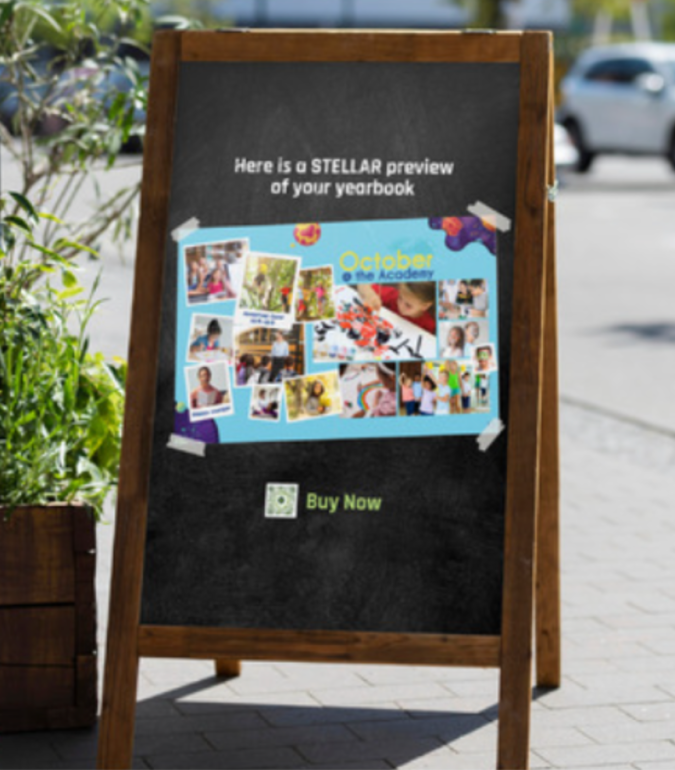

Three ways to choose a yearbook theme package
The main purpose of a yearbook theme is to capture the uniqueness of the school year while setting the tone for the story the yearbook will tell.
Without a unifying theme, our yearbook contains only arbitrary events and students. Theme functions as the understated but essential ingredient to make this year’s story meaningful.
Theme 101: visual and verbal elements
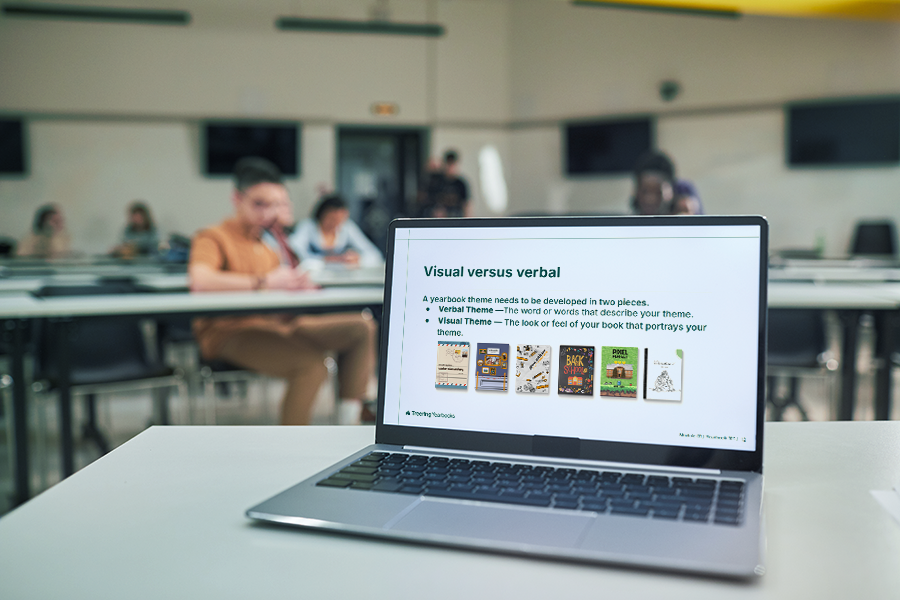
When it comes to yearbook themes, many of us stop at the visual. When you have a great theme package, it's easy to do. Combining both visual and verbal theme elements take your design to the proverbial next level.

Visual
This is the easy part: making it pretty. When you have a codified collection of graphics plus a color palette, you can use your visual elements to do more than make your book pretty. Check out the example above: graphic elements are used to draw attention to the pull quotes. Stylized numbers (really an editable shape under a text box) match the photo to the caption.
Verbal
The vocabulary you use in your yearbook further communicates your yearbook theme. These verbal elements can be punny headlines or idiom derivates from your theme. While you don't want to overdo it (think the Coco Chanel rule), take time to add a lexicon to your theme brainstorm.
Here's what it looks like: the yearbook theme is Stay Gold. Students look up idioms for gold and compile lists of how they can be used. For example:
- Golden Age of the Bulldogs (opening)
- Heart of Gold (staff section)
- Gold Feet (soccer)
Whether you’re a Treering user or not, we hope your students' stories are told beautifully and authentically from cover to cover.

90 high school yearbook article ideas
Some yearbook articles practically write themselves (looking at you, sports and activities), but a great yearbook will feature additional articles that give a holistic view of your high school’s student body. Coming up with ideas for these articles is as simple as considering what the students will want to remember. We’ve broken down some potential ideas into categories. Even if you don’t use any of these exact ideas, we’re sure they’ll get your brain kicking into high gear.
School life
Academics are important, but high school is also about socializing, gaining responsibility, and becoming an adult. Some of the most vivid memories are created outside of the classroom.
- Most embarrassing moments
- Hitting the snooze bar: do or don’t?
- Homework style: git ‘er done or procrastinate?
- Worst school-related nightmares
- Locker or backpack?
- Passing time during passing time
- This year I was proud of…
- Backpack must-haves
- Favorite class experience
- Lightbulb moments
- Making time for everything
- School uniforms: love or loathe
- What’s your commute: busing, driving, or walking?
- School rivalries: why we’re the best!
- Morning routines
Coming of age
Throughout high school, students are growing up. Each year brings unique challenges and changes. It’s fun to celebrate these milestones.
- First concert
- Getting your driver’s license
- Rock the vote: politics in school
- First jobs
- Taking the ACT/SATs
- What’s next?
- Summer job earnings: spend or save?
- Have you ever been grounded?
- AP classes or college in the schools
- Too old for toys?
- Childhood foods you’ll never let go
- Curfews
- Doing chores
- Naps: be a kid again
Leisure time
Sometimes school is more about the fun over the fundamentals. Reserve some space to tell the stories that are happening when the students are kicking back and listening to cassettes on their boomboxes (they still do that, right?).
- Gaming
- Fantasy football
- Favorite books
- Obsessions (Taylor Swift, TikTok, binge-worthy shows, etc.)
- Social media
- Hangouts
- Friday night social
- Garage bands
- Non-school sports (skateboarding, snowboarding, figure skating)
- How we shop: in-store or online?
- Constant communication: how many texts do you send in a day?
Current events
One of the most fun aspects of the yearbook is that it is essentially a time capsule. Up the ante by overtly including current events, music, and trends of the year.
- What’s in the news this year?
- Fashion trends
- Style inspiration
- All about hair, makeup, and beauty
- Favorite TV shows
- Music: best bands and favorite concert experiences
- Dance moves of the year (The Git Up)
- Knowing all the words to your favorite song
- Movies and blockbusters
- Seeing it first: midnight showings
- Your go-to memes/gifs
- New technology: wearable tech and hoverboards
Lunchtime
Whether it’s chatting with friends, playing games, or finishing up some late homework, a lot of stuff goes down in the cafeteria. With these ideas, you can focus on the food or the fun.
- Healthy or not?
- Best lunchtime traditions
- Droolworthy school lunches
- Who packs your lunch
- The best playground games
- Cafeteria workers tell all
- What school food will be missed the most?
- Who do you sit with during lunch and why?
- If you were cooking for the school, what would you make?
People
The most interesting part of anything (including high school) is the people. There are loads of fascinating dynamics, talents, and relationships to explore.
- Siblings
- Nicknames
- Unsung heroes: custodians, school nurses, and admin
- Friends since...
- Fresh faces: a spotlight on new teachers
- Who do you look up to?
- Hidden talents
- How did you become friends?
- Your biggest change in the last four years
- Legacies: kids who go to the same school as their parents
Places
Every story needs a setting, but these ideas turn the setting into the story.
- Rumors about the school: secret hallways, ghosts, hidden treasures
- If you could change one thing about the school, what would it be?
- The best restaurants in town
- Regional specialties (growing up near the beach, Texas football, big city living, etc.)
- Fun facts and quirks about the school building
- Spring break locations
- Where do you want to travel?
- Must-see locations in town
- Indoors or outdoors: where’s the fun?
Time of year and events
Over the course of the year, a lot of specific activities take place based on holidays or the season. You can use these triggers as a launch point to look back on the year.
- Homecoming parade
- Halloween: costumes and scares
- Thanksgiving and being thankful
- Seasonal activities: summer, fall, winter, spring
- New Year’s Eve: school resolutions
- Valentine’s day: love or loathe?
- Can we have class outside?
- Field trips
- Science fair
- Graduation
Categories lead to brainstorms
Hopefully some of these ideas will lead to some winning articles for your high school’s yearbook. If not, no biggie (we won’t take offense). You can still use these categories to springboard some new article ideas of your own design. Ask your students what they want to remember, and go from there.